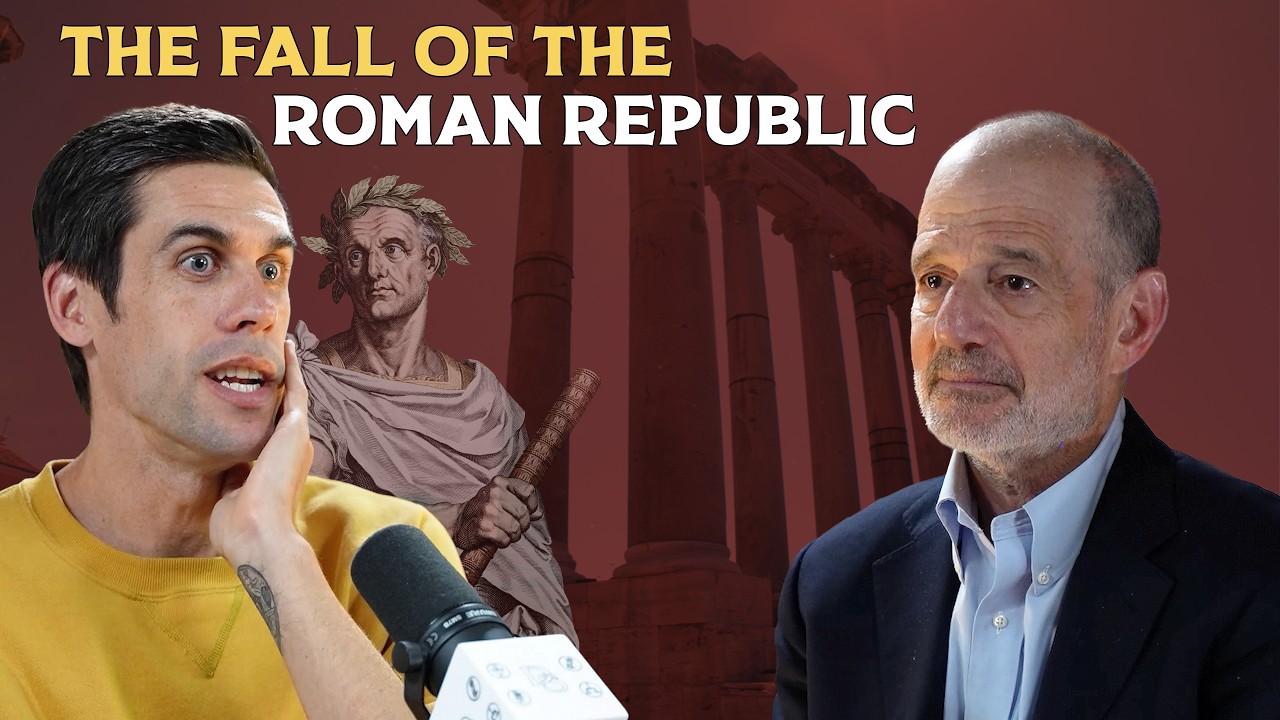
Video summary
Barry Strauss argues that the collapse of the Roman Republic was driven by a fatal combination of inevitable systemic changes and flawed individual choices. While economic pressures like prolonged wars, massive slave imports, and land grabs inevitably eroded the "civic bargain" between citizens and the state, it was specific decisions that sealed its fate; as small farmers were displaced, Rome lowered property requirements for soldiers, shifting their loyalty from the Senate to ambitious commanders like Marius and Sulla. This transition paved the way for military dictatorship, a trajectory influenced by contrasting figures such as Cato the Younger, who was principled but impractical in his refusal to compromise with reality; Julius Caesar, whose pragmatic ambition prioritized Roman prosperity despite ruthless methods; and Cicero, an eloquent thinker who ultimately failed due to indecision, allowing Octavian to manipulate him rather than serving a clear purpose.
The pivotal error that accelerated the Republic's end was the assassination of Caesar, which stemmed from the conspirators' naive underestimation of military power and their failure to secure better rewards for soldiers after removing their leader. Instead of stabilizing the state through compromise, these leaders attempted to violently preserve an obsolete system, a mistake Octavian exploited through cunning propaganda and ruthlessness to consolidate absolute authority. Strauss emphasizes that history is contingent on both broad societal trends and individual character; had future leaders adapted institutions to changing realities rather than resorting to revolution or force, the Republic might have survived longer. This historical lesson underscores that sustainable societies require virtuous citizens who believe in their institutions and are willing to evolve through compromise before facing dictatorship.
Beyond ancient history, the discussion highlights how modern society suffers from a similar fragility due to a lack of shared narratives and internalized norms, contrasting today's moral confusion with past generations steeped in recognizable historical archetypes like Catiline. The speakers contend that educational systems have exacerbated this decline by marginalizing humanities in favor of STEM fields and relying on rote memorization or AI-generated content, which often lacks critical depth due to hallucinations and a lack of genuine curiosity. To counteract this decay, there is a strong advocacy for integrating classics into modern education, urging engineers and students alike to study great books and engage in real-time debates about moral dilemmas rather than accepting superficial answers from technology or relying on devalued historical narratives.
Ultimately, the conversation explores how civilizations continuously borrow, mold, and reject ideas across cultures, as seen in the intellectual cross-fertilization between ancient Jewish texts like Ecclesiastes and Stoic philosophy, proving that great ideas are common property of humanity over time. The speakers conclude that rebuilding societal consensus requires a return to these foundational narratives to foster critical thinking and shared values rather than succumbing to moral relativism or technological dependency. By studying the rise and fall of Rome alongside universal ethical dilemmas, society can learn to internalize civic virtues through habituation and education, ensuring that institutions remain supported by citizens who understand both their history and their responsibility to adapt constructively for a stable future.
Read the full video transcript
Have you ever read Walker Percy's the
movie goer?
>> Yes, but a long long time ago.
>> I was rereading it recently and there's
this line in it where you know she says
like the age of Kos is gone or something
or the last of the Kos. Anyways, I was
thinking about it because what was so
funny to me about that is like I mean
Ko, it's not like he lived in a shining
moment in the Roman Empire. Like it w he
he's literally the last of of that,
right? Like
>> he literally watches the republic fall.
>> But also, I just took a special humor in
it in that Ko the Elder was concerned
that the end of Rome was the
introduction of philosophy, the thing we
now celebrate as the defining
achievement of these civilizations. I
mean, I hate to confess it, but I'm not
the world's biggest fan of Kada the
Younger.
>> Tell me why.
>> Because I think that he didn't
understand the need for compromise.
>> Yes.
>> And uh he did not have the strain of
pragmatism, which was one of the things
that made the Romans great.
>> Yeah.
>> Uh and uh you know, Caesar had a lot to
do with bringing on the civil war, but
Ko had a lot to do with it as well.
>> Yes. Do you think that he was a mediocre
politician or do you think he was too
principled and clean for the world of
politics or is it somewhere in the
middle?
>> I leaned towards princ too principled
and clean for the world of politics but
that makes him a mediocre politician.
>> Right. You know he wasn't he didn't he
wasn't good at the job. He thought that
uh all the problems could go away. All
they had to do was get rid of Caesar and
everything would be fine.
>> Yes.
>> But that wasn't true. Yeah.
>> I mean Rome faced
>> some fundamental problems. And the thing
about the Caesars and Pompies of this
world is that although the their
solutions for these problems were not
the solutions that were ideal, at least
they recognize the problems.
>> Yeah. Yeah. It's like he didn't
understand that actually the job of the
politician is to compromise on your
principles.
>> Yes. So my big line which I repeat
adnauseium comes from um this great
novel, The Leopard. And uh it you know
it's a novel about revolution in Sicily
in 1860. And the main character is this
old aristocrat who doesn't want to
change. Yeah. And he doesn't have any
children of his own, but he's very
devoted to his nephew. And his nephew
comes and shocks him and says, "I'm
going to join the revolution." And the
old guy says, "How can you do that?"
>> And he says, "Uncle, you have to
understand, if we want things to stay
the same, everything has to change."
>> Yes. This is an Italian novelist, right?
>> Absolutely. This is Queen Elizabeth's
motto. Queen Elizabeth II.
[clears throat] That is her motto in the
royal household that if things are going
to stay the same, things are going to
have to change.
>> She was a wise woman.
>> Yes.
>> Yeah. Uh I knew there was a reason I
liked her. But I I think that's
absolutely true. I mean, it's a little
bit cynical. Uh but I think it's it's
absolutely true. I mean, I I think that
what a politician has to do is to first
of all assess his or her society and say
what are the strengths? what are the
things that really what are the core
values that we really have to keep then
say okay but we can't have everything we
want what are the things we're going to
compromise on and we can't have
everything we want because the world is
always changing
>> um and so I think that a wise politician
understands that
>> and isn't there also a difference which
I feel like Ko maybe failed to
understand which is the job of the
politician in in the doing of politics
is to compromise on principles because
not everyone gets what they Yes.
>> But then the job of the public official
>> is to be unsuable from their personal uh
principles. So Kato refusing to take
bribes or to decide to run the treasury,
you know, honestly,
>> that is that's good principles.
>> And then hey, um
>> Pompy coming to you and proposing an
alliance even if you find him personally
distasteful. Uh if that prevents Caesar
from bringing him into his clutches,
right, that's a great compromise.
>> I agree. Yeah. I mean, I think that's a
really good example. And so that that
tells us both the strengths of Ko,
what's admirable about him and the
weaknesses of Ko?
>> Where does Cicero, if we have Caesar on
one end, Ko on the other? Is Cicero in
the middle, is he getting the mean right
or is he too principled or not
principled enough to be a good
politician? I think he's a better
politician than than Kato, but I think
that where he fails is that he too
didn't understand the impossibility of
keeping the republic the way that it
was.
>> I mean, the way I see it here, we have
Rome, which has is now ruling somewhat
like 50 million people. Yeah.
>> And the idea that you can have a charm
circle of a few families in and around
the city of Rome ruling this permanently
Yeah. without opening the doors to
outsiders, that's a non-starter. Yeah,
>> that's a no-go. And Pompy and Caesar
both understood that. Uh whereas Ko and
Cicero did not. And I think that's
that's what's so problematic about them.
>> Yeah. Yeah. Cicero I when I read about
them, I I at least admire Ko even if
he's frustrating.
>> Yeah.
>> And then
>> with Cicero there, I always have had
this sense. It's like he he knew better
or he could have done better. Like there
there's something disappointing about
Cicero in a different way. You know,
he's sort of always
>> checking the checking the wind. You
know, you wish he was you wish he was
more heroic and then it's almost like he
wastes himself on the wrong crisis.
>> Yeah, I know what you mean. But he was
not made that way. You know, he wasn't
he was a man of courage and a man of
principle. Certainly took a lot of
courage for him to stand up to Anthony.
the way that he did, but he was in a way
he was too clever by half and he was
vain. I mean, he allowed uh Octavian to
take him in.
>> Yeah.
>> He thought that he was using Octavian
yet Octavian was using him
>> and he also made the mistake of not
being able to keep his mouth shut and uh
the word got back to Octavian. So, I
mean, what a wonderful speaker, what a
fantastic orator, what eloquence uh and
a wonderful thinker as well
>> and how timeless the themes are, right?
the the politician who compromises too
much, the the politician who doesn't
compromise,
>> the the the ambitions getting in the
way, the telling themselves that they're
using the figure when actually the
figure is using them. Like just the
themes are
torn from today's headlines.
>> I agree. And Cicero's letters, I mean,
they're my favorite. I mean, just what
amazing amazing documents they are.
>> Yeah.
>> Yeah. My favorite story about Cicero is
I forget who it was, but some some
person had just sort of performed this
artistic [ __ ] you to to Caesar's face.
>> Cicero, you know, congratulating him
after says, you know, come sit next to
me, you know, and the man says, "Oh, I'm
surprised there's room. I you always
take up two stools."
[laughter]
meaning that he he never picks a side
and that that he had trouble he had
trouble sort of drawing the line which
obviously Ko did not
>> right
>> but there's sort of a vice in both
directions
>> yeah my favorite story from Cicero is
from the letter to Attacus where he
described Caesar's visit to his villa he
says at the end he's not the kind of guy
to whom you'd say come back again soon
[laughter]
yeah and Cicero at least there was a
consistency for Ko with principles. Yes.
Except for that whole weird thing with
his wife. Uh yes.
>> Uh but Cicero seems to like the
philosophy and like the the the image of
the stoic, but then also really likes
being rich and powerful and important,
>> right? Yes. Yes. So, so maybe for people
who have no idea what we're talking
about, walk us through in broad strokes
how it goes sideways. Why does the
Republic fall? Okay.
>> And sort of who are the players there?
>> Sure. I mean it's a long story first of
all as you know uh and it takes about a
century for the republic to fall. Yeah.
>> Uh but to make a short a long story
short I think it has to do with the
rupture in what colleagues of mine
called the civic bargain. And the civic
bargain is that uh Roman citizens would
serve in the military. Uh they defend
the country, then they go back to their
farm and they would enjoy a middle class
existence on a modestsized farm and they
would also be able to participate in
politics. It wasn't a democracy, but
there were elections and ordinary people
had a vote. And it all starts to go
sideways as a result of the wars that
Rome fought in the 3rd and 2nd
centuries. uh the wars that really you
know squeeze these people uh to the
pipsqueak. Um uh many of them die, many
of them lose their farms. At the same
time, Rome is becoming a major major
slave power and Italy is becoming a
slave society. Uh and the fat cats are
grabbing up all the public land that
ordinary uh Romans would need to pasture
their herds on.
>> So we see people moving to the city of
Rome because they can't make it on the
farm anymore. We see people losing their
farms. We see people going into debt.
And the net net is it this really
affects the Roman military because the
Romans staunchly believe that you could
not arm poor people cuz if you armed
poor people, they could turn on you. And
they also thought that poor people were
poor. I mean unfairly. They thought that
poor people were poor because they
lacked virtue and they just didn't have
the right stuff. Yeah. Uh so suddenly
there's not enough people who can meet
the military the property qualification
to go into the military. A Roman
politician, well two Roman politicians,
the Grai brothers try to do something
about it by redistributing public land
and getting the wealthy to give up this
land and to share it with the poor so
that you can bring potential Roman
soldiers back up to speed where they can
meet the property qualification.
>> But the first moral panic about
socialism.
>> Yes. Yeah. [laughter]
In a way, yes, you could say that. So,
uh, this leads to a violent opposition.
I mean, literally violent opposition.
And there are lynch squads put together
by senators to kill each of these
brothers in turn and to uh make these
reforms more abundant. They're also
afraid, the the old guard was afraid
that as a result of this uh that the
Grai brothers would have unassailable
political popularity. So Rome's in a
dither about what to do or in a tizzy
about what to do and ultimately when
they face a challenge from Celtic
invaders at the end of the second
century uh or they also have a crisis in
the war in North Africa uh what they're
forced to do they constantly have to
lower the property qualification
accepting poorer and poorer men into the
military. Uh and finally I say no more
property qualification. Anyone can
become uh a any citizen can become a
Roman soldier. And so you have these
poor people who go in the military and
their commanders say you know fight for
me fight for Rome. And they're saying
well why? And they're saying because uh
at the end of the rainbow there will be
a pot of gold and the pot of gold will
be that we will I will I will get you
land. They would settle the soldiers in
these different kind of colonies and
areas of that they'd conquered, right?
>> Eventually, yeah, but not quite yet. In
this period, they're settling them in
Italy,
>> uh, which means they have to get land
for them, which often means they have to
take land away from somebody else,
right? So, they're sewing the seeds for
civil war. And what's happening is now
ordinary Romans instead of being loyal
to SPQAR, instead of being loyal to
Senatus Qu Roman, was the Senate and the
Roman people, they're now loyal to their
commander. You know, I'm Marius's guy.
I'm Sullah's guy. So they're not really
loyal to the republic per se anymore,
but but to the guy who represents the
republic to them. So citizenship has
really changed its meaning and Rome is
in danger of becoming a military
dictatorship.
>> [gasps]
>> So as you know there's a long and
complicated uh civil war a set of civil
wars between Marius and Sullah and when
Marius dies between his partisans and
Sullah wins very brutal war he is on the
side of the conservatives the old guard
the people who call themselves the best
men whereas the other side of the people
who call themselves the men of the
people
>> we might call them populist is a little
misleading but it's close uh to uh what
they are And Sullah comes in and makes
himself dictator kind of twisting the
meaning of an old Roman institution
that's supposed to be temporary. He's
dictator with uh without any uh time
limit on it. And he uh reforms the
constitution to try to turn the clock
back before you had all these populists
to try to make Rome back to the
conservative way it was before. But he
steps down after a year. Probably he was
ill because he dies shortly after that.
And the republic is back in business,
but slowly it devolves until what it had
been. And
>> this gets us cuz Sole and Ko overlap,
right? So like Ko's a young boy during
Solah's reign. So Caesar is and so is
Pompy Pomp. So we're now in the 70s
around the 70s BC.
>> So here's the republic. It's very
lively. There's a lot of debates. It's
very active. But there's also a lot of
tension because the republic is
depending on these big guys, the big men
who are going to represent uh Pompy and
Caesar come to the four. There's also a
third one as you know, Craas who also
wants to be one of the big boys and one
of the great military leaders. And the
other thing that we have to factor in is
that in a way successor spoiled Rome and
the old-fashioned Romans who were afraid
of the Senate and who respected the
power of the Senate are being replaced
by new generations who think you know
I'm really hot stuff and I should be
ruling the world. Um so you get that
with Pompy, you get that with Caesar.
Craas would have liked to do that but he
fails of course. Uh and that's part of
the story as well. These are people who
don't respect the old rules. Rules are
for suckers. Um
>> the institutions are slow and
ineffective and holding us back.
>> And don't you know how great I am? Um so
there's part of that as well. So on the
one hand, it's a society that's still
playing by the old rules, but on the
other hand, there are people who won't
play by these old rules.
There are populists as well who are, you
know, really riing up, roing the system.
They're riing things up. Uh there's a
lot of tensions going on. I mean,
scholars disagree. I mean, one of the
great scholars of Rome, a man named Eric
Gruin, uh argues that the republic could
have survived just fine. It was
assassinated.
>> You know, it did not commit suicide. It
was assassinated. Uh and it could have
gone on.
I think it could have gone on, but only
if it had been willing to make
compromises with reality. And in the
end, it wasn't willing to make those
compromises with reality. In fairness,
it was really being pushed to the limit
by Pompy and
>> and Caesar.
>> It's like they're driving a car too fast
and it's starting to shake under because
it's hitting it's it's hitting up
against the limits of what it's capable
of of withstanding.
>> Absolutely.
>> Yeah.
>> Absolutely. So, um, it's unclear how
they're going to solve this problem. Uh,
and in the end, led by Ko, they say,
"We're going to solve this problem by
going for the jugular. We're going to
get Caesar, you know, we're going to
strip him of his command and Gaul. We're
going to put him on trial, and he's
going to be condemned to death. So, what
he's going to do is he's going to go
into exile." Yeah.
>> Um, and that'll be the end of him. End
of problem. Get rid of the guy who's
putting the most pressure and strain on
the system. That's right.
>> Bumping up against its limits. Yes. And
then things can all go back to normal.
>> That's right. And in the meantime, Pompy
uh who was allied with Caesar for a
while, realizes that his star is going
into eclipse and Caesar's is rising and
he decides, what do you know? I was a
conservative after all. Who knew? So now
I'm on the side of the Senate and I will
I will fight Caesar on their behalf.
>> Yeah. So, a couple things I'm taking
from your version of this story. Number
one, you know, we go like the fall of
the republic and we think about it as
like Caesar, Ko, Pompy, whatever.
>> But like first off, you're dating it
back almost 100 plus years. And then and
then this isn't getting into sometimes
people conflate the fall of the republic
with the fall of Rome itself, which is
hundreds of years after that.
>> Yes. I think there's a there's a common
thread by the way between the two of
them, but yes, it's 100 years after
that. And the common thread is just
compressing an immensely complicated bit
of history down into a a single thing or
what's the thread?
>> I think the thread is citizenship.
>> I mean I think the thing about republics
uh is almost what Churchill said about
democracy. It's the worst form of
government except every other form of
government.
>> Uh republics have this have debate. They
have citizen activists. Uh they are
unruly but they're also incredibly good
at mobilizing the people. behind a
cause. Uh when you have politicians that
know how to do that,
>> it breaks down in the republic. By the
time you get to the later Roman Empire,
>> citizenship has it hardly exists. The
Senate doesn't really do anything
anymore. It doesn't have any real power.
There haven't been assemblies for a very
long time. The people of Italy uh live a
privileged life. Uh after around the
year 200, there are no soldiers who come
from Italy anymore. All the soldiering
is being done by people from the the
frontier provinces. Yeah. It doesn't
mean they're bad or disloyal to Rome. It
just means there's no way to mobilize
Yeah.
>> the the citizenry. There's no way to
turn the ship around very easily. Um and
so Rome is at the mercy of a few leaders
and and unable to make the kind of
changes that would have been needed. It
would have been very difficult but not
impossible uh to keep the empire going.
I [music] was just on this tour down the
west coast of the United States where I
was giving talks. Booked a bunch of
different really cool houses on Airbnb.
We [music] stayed in Breton right on the
water. We stayed in Mendescino and then
we made our way down to San Francisco
[music] and Sacramento. That was fun.
We're heading to Europe this summer.
Booked this amazing place on Airbnb. And
[music] I always think when I check in
like, oh, these people might be doing
what I was doing all of those years ago.
A lot of people don't know this, but
actually one of the reasons I was able
to transition from my corporate [music]
life to being a writer is that my wife
and I used to host our first house
[music] on Airbnb. Austin's a great town
cuz there's all these big events.
There's South by Southwest, there's ACL.
When I started to make it as a writer
and we moved out to the country, we kept
[music] the house. It stayed on Airbnb.
I would work there during the week and
then on the weekends we'd have guests.
And this was a just a little business my
wife and I [music] had on the side. My
point is, your home might be worth more
than you think. Find out how [music]
much at airbnb.com/host.
>> So, I almost wonder like from a there's
obviously there's sort of the the
systemic explanation of history,
economic causes, uh, historical forces,
etc. And then there's the sort of great
man of history theory, which is like
individuals are responsible. Everything
would have been different if this person
didn't exact. What's interesting about
the the fall of the republic is it's
kind of those two things intersecting
with each other
>> intersect and it's it's like the answer
is both.
>> This is the Strauss version of history.
It's messy. There's not just one answer.
Society and economics matter. Culture
matters, but individuals matter as well.
You know, if you hadn't had Caesar and
then if you hadn't had the incredibly
cunning, clever, unscrupulous, ruthless,
murderous, but visionary Octavian. Yeah.
>> You know, it wouldn't have ended up as
the way it ended up, but it might ended
up as an Egyptian empire, which could
have been totally different.
>> Yeah. Or the events and the trends give
rise to the opportunity to the
individual, and then the individual has
the choice, are they going to be a a
Caesar or a Catis? That's right.
>> Um and it was this kind of convergence
of right man, right time, or wrong man,
wrong time. And and that's what changes
the arc of history.
>> Yeah. I mean, I think if you look at the
founding, uh, if you look at the
American independence, how amazing that
was. I wouldn't say it was totally
unexpected. The British foreign office
or whatever the colonial office,
whatever it's called at the time,
certainly had toyed with the idea, gee,
if we defeat the French, it'll be great,
but there's one problem. The colonies
won't need us anymore. Yeah.
>> Uh, still, the fact that the rebels were
able to pull this off is kind of
amazing.
>> And then that Washington makes the
choices that he makes, right? He could
have he could have fought a more
traditional war. That would have been
different. He also could have decided to
make himself king or any number of the
founders could have decided to to go in
a different direction. And
>> it's this remarkable set of choices.
>> Yeah.
>> And they had the benefit of obviously
looking back at the previous choices and
going, "Hey, how did it go last time?"
>> Yeah. I mean, Washington, of course, was
a huge fan of Ko, but the Ko that he
loved was the Ko of Addison's play. Yes.
From the early 18th century. who's not
really the real Kate, not the historical
Kato. So, it's imaginary KO.
>> He's Lin Manuel Miranda's Hamilton, not
actual Hamilton.
>> Yes, exactly. Imagine. Yeah. Imagine if
our leaders used that the the Broadway
version of Hamilton. Yes. There could be
worse things, but
>> No, in a way it was perfect, right?
Because I mean, he is a a tragic figure
in the play, but but it's a play
celebrating primarily the virtues of the
person.
>> It is. And the Addison version of Ko is
the the virtues of Ko, not the
frustrating, obnoxious, ineffective
version of KO.
>> Yes. Yes. Absolutely. Yeah.
>> They make these choices and and then it
works out the way that it does, but it
it always could have gone otherwise.
>> Absolutely. History is contingent.
>> Yes. Are there are there a handful of
choices when you look at the fall of the
republic that you go, man, that was
really a pivot point or you're like, I
really hoped he would go in this
direction or is there anything that
stands out at you?
>> Well, certainly, of course, the most
famous one is the crossing of the
Rubicon. Yes. You know, the fact that
Caesar decides to start a civil war
rather than giving in. You know, a less
determined and less selfish person might
have said, "Look, you know, I love
myself, but I love my republic country
more, and I don't want to put the
republic through this." Caesar doesn't
say that,
>> right?
>> You know, he could have been a more of a
MacArthur figure who was done an
injustice, and some I mean, sort of
deserve to get fired in my view, but but
like when MacArthur is called back from
Korea, he could have made himself a a a
more Caesaresque figure than he did.
>> Yeah. I mean, William Manchester wrote
this book, I think, American Caesar.
>> We have it in the bookstore next door.
Yes.
>> It's a really interesting book, but in
the end, he wasn't a Caesar,
>> right?
>> He makes the choice.
>> Yeah. He makes the choice. Caesar
decides differently. You know, he says
[clears throat] famously, "My dignitas
is dearer to me than life itself. My
dignity, my rank, my status." Yeah.
>> I mean, what that's a very unamerican
thing to say, but it's a very Roman
thing to say.
>> Yeah. Yeah. Although an American might
say my reputation is the I live or die
on my reputation.
>> Yeah.
>> Not quite the same thing,
>> but the but sort of built into the
American story up until relatively
recently was always country over self.
>> Yes.
>> Right. And that that was a powerful
norm.
>> Yes.
>> That that saved us in some some narrow
run moments.
>> Yes. And well, I don't want to get off
topic, but we could talk about why we
don't have that anymore. Yeah.
>> Okay. I mean, I think the Romans and
Greeks would have said it's very simple.
Uh, success spoiled America.
>> Yeah.
>> Luxury. The arrangements believe that
luxury was the greatest enemy of
republics and that to have a republic,
you need to have just a little bit of
want, desire, need. You got to keep
people hungry. You can't have people
thinking the most important thing in
life is getting rich and being able to
afford $7 lattes every morning.
[laughter]
Don't you think part of it is also
though like and and this is why Ko the
elder was concerned and Ko the younger
was concerned which is like
the norms persist as long as people
continue to believe in them and the
story is told and retold and each
subsequent generation is inspired and
steeped in the conditions that make the
norm logical and celebratory.
>> Yes, but you have to educate people.
Yeah, that's what I mean. You lose the
ability to do that perhaps in
prosperity, but also because you so take
it for granted that everyone understands
>> you take it for granted. Yeah. You know,
so when I was growing up during Vietnam,
uh people would sneer at patriotism.
Yeah.
>> You know, uh I'm not saying we had to
support the Vietnam War, but I think
that people went beyond that and say
there's just something wrong with being
>> a super patriot, as they would have
said. And that can lead people too far
in the other direction just challenging
everything
>> when it's a feedback loop, right?
Because you start to question the idea
of patriotism exactly at the moment that
your government is proving itself to be
not worthy of the trust or faith and
then this downward spiral that they
experienced in in Rome too.
>> Yes. Absolutely. I mean, you have to
fulfill your part of the bargain and
give citizens the thought that this is
the way to go. It's not It's something
they should love, but there's a reason
why they should love it.
>> Yeah.
>> It's hard to sell to people. Even if it
doesn't work for you, you should still
love it. Which is true, but it's hard to
get people to
>> to see that.
>> You should fight in the war that even
your average citizen sees as a bad idea
and not going well.
>> Uh but that is the the Roman way like
the the there was this kind of
unquestioned obedience. I I think of
that story. I forget who it was. It's
the famous Roman myth of like the the
the hole opens up in the ground and Rome
will only be saved if its most valuable
things are thrown into it and that Roman
gets on his horse and he dives into the
hole. Do you know this?
>> I'm vague v vaguely I'm afraid I'm
drawing a bit of a blank.
>> But the point is like unquestionably he
just I'll I'll kill myself to to save
Rome.
>> Well, Dishius Muse I mean he's the guy
who engages in self-sacrifice for the
sake of Rome. Yes. I mean yes that is a
Roman story that the Romans told
themselves and they had to believe um
that it was worth worth doing that for
their society. You know the other thing
about it is it's easier in a way when
you have an external enemy
>> and you feel that you have to make
sacrifices because of the cause. Um I
mean I think one of the things about the
cold war and even even more after the
cold war was we felt we weren't really
at risk. I think maybe people had felt
in the 50s they were, but as things
started to calm down a bit, I think less
and less people thought, "No one's going
to start a nuclear war. We're not really
at risk." And then after the Cold War,
we thought, "Oh, we're number one."
Yeah.
>> You know, it's a a uni-olar moment, as
they said.
>> Well, and then also, I mean, this is
getting a little too modern, but like
the the idea of an existential godless
enemy, right,
>> did I think bind the sort of
conservative movement
>> Yes. into the sort of well we're not
going to be opposed to everything. We do
understand there are some things more
important like it kind of brought
everyone on this team of like hey
>> yes
>> we at least agree on foreign policy that
we all hate the Russians.
>> Yeah. Or the Soviets. And I mean I think
many many liberals felt the same way.
You know they said we're not down with
conservatism but we don't want
communism.
>> Yeah. Yeah. So another pivot point that
I think a lot about again stoicism is at
the center. the decision to assassinate
Caesar, right? We have Yes. We have
Brutus, right? We have Kato's daughter.
>> So, obviously, there's the decision to
do it, which is a pivot point, right?
>> But then there's also the sort of it
strikes me as similarly naive in that
they just thought
>> we'll strike at the king and then the
movement evaporates. Like there there
was effectively no plan as to the day
after.
>> Yes, they did not. I think they
underestimated the military. They had
thought it through some and they thought
that, you know, what we need to do is to
say to Caesar's soldiers, we know Caesar
has given you this enormous amount of
wealth. He's rewarded with enormous
amount of wealth and you can keep it.
>> Yeah.
>> But what they didn't realize is that in
order to win over Caesar's soldiers,
they need to say, "And we're doubling
it. We're giving you more." Which in
fact is exactly what Octavian does a bit
later. That was their mistake. I mean,
just think of I imagine this assembly a
few days after the assassination where
Brutus is addressing the crowd and he
says, "You guys don't have to worry. You
can keep what Caesar promised you." I
imagine them thinking, "That's it.
[laughter]
>> We want more. He killed our leader. We
got to pay. You got to pay up." Um, and
they
>> they knew they they were in the cat bird
seat and that they were the swing vote.
>> Yes. They were the swing vote and it was
just a matter of a leader arising who
could organize them. Yeah.
>> In the end, two leaders arise, Anthony
and Octavian. And Octavian just turns
out to be infinitely more cunning and
ruthless than Octav Anthony. Not that
Anthony was a slouch. He wasn't. Yeah.
>> But uh Octavian could outfight him.
>> And he wanted it more.
>> Don't you think?
>> Uh
yeah, I think he he wanted it more, but
he was willing to just do sleazy stuff
more than than Anthony was. I just been
Anthony wanted to
party a little bit.
>> Yes. But remember, we're only getting
the version that Octavian wants us to
have because Octa Anthony didn't live to
tell his side of the story. Sure.
>> So the version we get was this guy was
just a drunkard. I confident that the
real Anthony had a lot more on the balls
on that. He's obviously very savvy and
adapt and driven and ambitious, but he
does terry there in Egypt for a bit in a
way that I don't know if Octavian would
have.
>> Again, he we're getting Octavian's
version of the story. I mean, Cleopatra
is not just, you know, a fabulous uh
lover. uh she also is herself she's a
very cunning strategist and she's the
richest person in the world and she has
access to all the savvy of the Tomic
Kingdom when it comes to naval stuff in
particular right
>> so uh Anthony has there's a lot of
reasons to want to be with Cleopatra and
also finally she's Caesar's girlfriend
she's Caesar's woman
>> that's the link to the past
>> she's the link and also she comes from
the family of Alexander the great's
general I mean it's tremendous propag
propaganda PR advantage for for being
with her. Uh she's also a goddess. Uh
she's Isis on earth and uh as her
consort Anthony is Osiris and he's also
she's Aphrodite and he's Dian Isis and
we might think oh who cared about that
but they did in the ancient world.
>> It's like finding out you could be pope
or something like in addition to a head
of state which is like wow.
>> Yeah. Yeah.
>> So, you know, yes, he did tarry in Egypt
some, but again, we're getting this
propaganda from, you know, August,
Octavian Augustus is one of the masters
of propaganda in all of history, you
know.
>> So, as far as lessons, okay, so
citizenship matters, the bargain with
with your people matters. Obviously, the
individual choices and the character of
the leaders matters.
>> Any other big lessons you feel like we
draw from this story? Well, the economy
matters. You know, it's the economy,
stupid. You know, uh, one of the things
that I hear from young people all the
time nowadays is, "We can't have the
American dream." Yeah.
>> You selfish baby boomers took all the
money. Uh, and we can't have it. We
can't
>> we can't buy a house. We can't have kids
because it's just too expensive.
>> Sure.
>> Um,
>> also, you wreck the environment. You
wrecked the environment. Everything is a
mess and you're expecting us That goes
back to the bargain, right? Everything's
a mess and you're expecting us to play
by the rules and have faith.
>> Yes.
>> And that's looking like a bad bet.
>> It's looking like a bad bet. Plus, we
have to spend all this money to go to
college and then we come out and we
can't have a job because it turns out
that all the stuff we were promised with
a college degree turns out to not be
true as you know very well. So, um, and
they have a point. They have they
absolutely have a point.
>> Yeah. So, I mean, when you have a system
that's due for change, the question is
going to be, well, is it going to have
to be violent change? You don't want it
to be violent change. How can you evolve
the system?
>> Yeah.
>> How can you make uh changes in the
system? So, I would say we want to throw
into the the hopper um
>> compromise. Compromise being a value.
And I think that's really important in
republics cuz republics depend on debate
and they depend on people vigorously
disagreeing with each other but it can
go overboard. Isn't that the genius of
say like uh an FDR in that there is a
moment it's clear the thing is not
working. It's clear the bargain has gone
bad and then there are the the people uh
who for whom you know the system has
worked or they are really principled in
the sense that they believe in hey this
is what the founders wanted. Sometimes
it goes like this
>> and they don't want to change and he
says sorry guys
>> it's this or revolution and he figures
out how to change within the system
without violence
>> and sort of mitigate some of those
>> it is the genius of FDR and I'd say even
more so the genius of Lincoln. Yes.
>> You know the ability
>> to compromise but also understand
there's some things you can't compromise
on. Right. So, you know, getting that
right and then keeping your head,
keeping together during this terrible,
terrible crisis. I mean,
>> right. Yeah. It is interesting with both
FDR and Lincoln. They could have been a
Caesar figure and there were people who
accused them of being that at the time
and obviously they both shattered norms
whether you're talking about ABS Corpus
with with with Lincoln or you're talking
about the decision to run for a third
and then a fourth term with FDR. But it
was within some self-imposed limits.
>> It was It was within some self-imposed
limits. Absolutely. Yeah.
>> Although maybe Caesar would have said,
"I could have gone further. I chose to
stop here and then you stop me before I,
you know, was able to to sort of turn
this thing around." But
>> becoming dictator in perpetuity is
pretty far.
>> Sure. Sure. [laughter] Sure. Sure. Yeah.
it. But it is interesting how how at
some level it ultimately does come down
to the character of the person who finds
themselves in that moment and what
they're willing to do or not willing to
do what they believe and what they don't
believe.
>> I mean, Caesar did not have to bed the
queen of Egypt and produce the next king
of Egypt as his his illegitimate son.
Yeah. And he did not have to tolerate
her being stashed in his villa on the
other side of the Daper River while he's
living with his wife in downtown Rome. I
mean that I think is one of the uh
untold reasons. It's unsung story
because it's not in Shakespeare uh for
>> that made the Romans very nervous.
>> It made the Romans very very nervous.
Yeah. Very very nervous.
>> I think it's so interesting again the
Stoics not being pragmatic. But the
first thing is it it's it's either
Athenodoris or Aris Ditimus. I forget
one of the teachers of Octavian he goes
you know one cannot have too many
Caesars. And and that's the indirect way
of saying you got to get rid of uh
>> of Cesarian. And and so the Stoics do
learn a little bit late that power
requires a certain amount of
ruthlessness and pragmatism.
>> Yeah. Caesar of course was an Epicurion.
>> Yes.
>> Yes. And sort of got along with the
others. But at some level, you know, he
probably thought Ko was a sucker at some
level.
>> I think so. Yeah. Yeah. You know, Caesar
is quoted as saying, we don't know if he
really said it or not because it came
from from an enemy. The republic is a
mere name, all form without substance.
[laughter]
>> Yeah. There's at the center of Caesar is
Caesar.
>> Yes.
>> And at the center of Ko is these
principles and ideals and something more
abstract and theoretical.
>> Yes. But let me defend Caesar a little
bit. I mean, Caesar really does believe
in the Roman people. Mhm.
>> Um and both in the rights of the Roman
people and also in taking care of the
Roman people and making sure they had uh
prosperity. I mean there's an Italian
scholar who wrote a book called Caesar
the Democratic dictator.
>> And I think that's going too far. I
don't think he was a democrat but he did
care about the people in the way that ao
did not really. Yeah. That is that is
something that you find both in the
ancient world and in the modern world.
There is this okay sure the principle is
important you are right
>> but people are starving in the streets
if the government is failing to do its
job it doesn't matter that I think
Lincoln said this he's like the
constitution is not suicide pact okay
you know like like you can't expect me
to stay true to these things if it means
people can just leave the compact of
states at any time or whatever and Ko I
think I mean he does famously commit
suicide he probably didn't have a
problem with principles being a suicide
pact. I think he kind of thought
[laughter]
at some level thought that was the
highest expression of their value.
>> Yeah, I think that's true. Um and he was
ahead of his time because suicide hadn't
become as highly regarded as it would be
when in the next century under the
Stoics.
>> Yeah, it's highly regarded. No, but it
it it was a dramatic act of devotion. He
thought not cowardice or weakness, but
like the monk in Vietnam lighting. sets
himself on fire.
>> It's funny. I'm reviewing a book about
Carthage and I realized that one of the
things we remember about Carthaginians
is the ones who committed suicide. Yeah.
>> Like Hannibal and Daido.
>> Yeah. I was reading um Andrew Roberts's
biography of Napoleon a few years ago
and he has this great section which came
out of no where where Napoleon is just
[ __ ] on Ko.
>> He's like, you know, Ko, he committed
suicide and who did it help? Caesar.
What did it accomplish? Nothing. You
know, and and like on on the one level
he's right, and then on the other level
you're like, well, of course Napoleon
doesn't understand. Napoleon is a
Caesar. Of course, he doesn't respect a
KO.
>> Yes. Absolutely. Yeah.
>> It's almost like these figures are just
speaking totally different languages and
they can't understand each other and
they think the other one is the crazy
person. [gasps]
>> I think that's true.
>> Yeah. And ideally the purpose of
institutions I guess and this is what
the founders I think did well although
it's clearly under strain these days is
like
>> how do you create systems or structures
that channel some of that energy allow
it to dissipate and we've managed to
head it off for 250 years but the
pressures remain.
>> Yeah. And the you're absolutely right.
And the thing about institutions though
is that you need to have the societal
underpinnings. Yeah.
>> That make them work and that make people
say yes, this is the right way to do
things. Yeah. If it's just a piece of
paper,
>> you know, it doesn't mean anything. John
Adams famously said, "Our Constitution
will only work for religious people.
>> It's not not suitable for anyone else."
>> And maybe we could substitute religion
for principles. He means like a Yeah,
because it is funny because I was just
reading something the other day where he
was reassuring in that treaty against
the Tripoli pirates or whatever, he was
like, "We're not going to wage a war
against the Muslims because we're by no
means a Christian nation."
>> Right. Interesting.
>> So he said that but I think his point is
the constitution only works and he said
this more explicitly somewhere else like
if the people are virtuous.
>> Yes.
>> Absolutely. Yeah. And you know the
constitution doesn't say much about that
and that was left to the states and it
does talk some of the state
constitutions do talk about that.
>> Yeah.
>> But education is an unspoken thing.
Yeah.
>> And it's enormously important. TOEFL of
course does talk about that more and
does get it that you don't have
democracy in America because you have a
piece of paper. You have democracy in
America because it lives in people's
hearts. Yeah.
>> Uh and it lives in their hearts because
that's their way of life.
So I mean I think that is a challenge
for us today is is it is in any
generation you you can't rest on your
laurels you have to come up with
more ways
>> yes that
>> well you also I think were realizing
today just how as explicit as the
constitution is and then they made it
more explicit with the bill of rights
>> that it is primarily a system of
government centered around a bunch of
unwritten norms like it's more British
than we thought it was.
>> That's a good way to put it.
>> And then it's very hard to continue
those norms if you get to a point where
suddenly everyone
>> there what's that thing the chest
Chesterton uh fence thing where it's
like we don't know why the fence is here
like we don't know what why is there a
norm that this can't happen or that
can't happen. Why does the president
have to voluntarily leave after two
terms or like all these norms like pard
the pardon power was in obviously you
can't pardon yourself and you can't
preemptively pardon people for crimes
they haven't committed and you can't
dangle pardons in front of people for
committing crime like that's not
explicitly set out anywhere but but
George Washington would have barely
conceived of someone conceiving of doing
such a thing
>> right I agree with you but you can't
enforce norms by saying we're going to
enforce norms, darn it. You know, you've
got it's really got to be in people's
hearts and they have to be educated this
way. I mean, Aristotle talks about the
important of habit and habituating
people in education. And I think that's
>> that's just so important. I think one of
the reasons our societyy's in the
trouble it's in today is because of the
educational system.
>> Yeah.
>> And and the way we don't raise people,
the things we do teach them and the
things we don't teach them.
>> Yeah. And and the way it was for the
founders is they're so steeped in the
stories that the characters that you
write about in the books and not just
like they're signing the federalist
papers with their fake Roman names, but
like if you had called uh someone a
cataline or whatever, they'd they'd all
have known. And then if you if you
called Trump a cataline, like what
percentage of the population is like
what are you talking about? [laughter]
>> You know, they just don't it's like
we're only able to say someone's like a
Hitler or Martin Luther King. like we
have like five people we can name. We
don't have the sort of historical
narrative that that is so rooted in why
we have certain systems and what certain
norms are.
>> Well, Americans have often devalued
history. I mean, it's not an accident
that it was Henry Ford who said history
is bunk. I mean, you know, Americans
live for the present and live for the
future.
>> Yeah.
>> We we don't really live in the past, but
we need to
>> study history. I mean, we really do.
>> It was funny. So, this thing I was at
yesterday, they were the guy was talking
about he' taken his kids to New York
City and they they were at this museum.
They were looking at all these classical
sculptures and history
>> and that was all very impressive and
then they went to this play and it was
full of woke garbage, you know, he was
ranting about this,
>> you know, there was transgenderism and
it was like, okay, first off, the Romans
that you're celebrating, they had a lot
of sex with guys, okay? [laughter] I
think you would be I think you'd be
horrified at at what you were what what
Roman culture Greek culture was actually
like. But that's neither here nor there.
There is this sense that those
civilizational values are in retreat or
decay.
>> And what do you think you do about it?
What what do you do about it?
>> I think you have to I I mean I'm very
platonic about this. I mean I think you
have to educate the young. Yeah. I mean,
you're not going to have the society you
want unless you educate the young in the
way that they need to be educated.
>> Uh, and you know, Plato gets that 100%
right. So,
>> I think that's what we have to do. I
mean, that's my job as an educator to
think about how we're going to educate
young people. What are the stories we're
going to tell them? What are the books
we're going to have them read? What are
the ideas that we want them to have?
What are the practices we want them to
engage in?
>> And I think as a society, we've been
kind of less afair about this. uh and
not taking it as seriously uh as uh we
need to do. You know the American thing,
those who can do, those who can't teach.
I mean,
>> okay, yeah, I get it to a degree, but
those teachers are really important. And
what we teach our kids and how we teach
our kids is some of the most one of the
most important things that we can do.
Well, it's like this STEM stuff is
really important, right? It is. And at
the same time, if you if you go, "No,
get an engineering degree or you got to
learn how to do something that'll help
you get a job. What are you studying?" A
bunch of It's like it's like the the
humanities and these stories got taken
out by both ends. It's like the this
isn't practical. I'm not paying you to
go to school to be a philosopher. And
then also,
>> it's just a bunch of old dead white guys
uh who who were slave owners. Screw
them. What do they what can they teach
us? And so we we end up cutting down our
sort of shared consensus and
understanding of those values in both
directions. And then we're like, why
don't people believe in this stuff
anymore?
>> They don't It's not they don't believe
it, they don't even know it.
>> They don't even know it. Yes. They don't
even know it.
>> And that's that's the problem. We really
have to put it back on the agenda that
young people are learning about this.
>> Yeah.
>> Um and tackling these ideas and thinking
they're important. I mean, so I'm
visiting the school of civic leadership
at at Texas and one of the things I like
is the fact that you can do a minor. I
don't know what they call it, but taking
I believe it's six courses in civic
leadership and they've got engineers who
are doing this. I think I think that's
great. You know, I think that's the kind
of thing that we need to be doing in our
universities and we have to say to
people, you really do have to read the
great books and you really do have to
join the great debate and be part of the
great ideas. Of course, you can be an
engineer. We want we need more
engineers. In fact, uh, but we also want
you to have some sense of this. And of
course, it's almost too late if it just
starts in university.
>> Yeah, I was just going to say, you know,
my nine-year-old's obsessed with Greek
history and, you know, having these
discussions about the Odyssey. Should
should Odysius have done this? Why? Why,
you know, was it right to not tell the
men as they're going through Sil and
Terminus that that six of them are going
to die or, you know, should he have
shouted out who he was to Polyis? And
and you're talking about these things
and and you realize like did the Greeks
and the Romans really think Odysius was
real and that this happened? I don't
know. And and I I would suspect no. I
think they knew that this is all myth,
but the purpose of history to them was
not always to be factually correct in
the way that we have to root everything
in primary sources. Like Plutarch's a
great biographer even though he's not
super accurate because he's getting to
the essence of these figures.
>> You know, he's not bad, by the way, as a
historical source. You can't really
trust any of the speeches that he gives
because ancient historians didn't think
it was their job to tell what people
really said. It's what they should like
a recording.
>> No. uh but I think he's not bad on
historical facts but whether they
believed in their myth or not even
Aristotle quotes the Iliad you know so
>> but I mean the the primary purpose of
that history was to teach the value not
even the values but to to bring up the
moral debates that the incidents in the
the story forc us to wrestle with you
know and and the idea of uh yes Caesar
crossing the Rubicon is both a
historical event and then a moral
question for all of us in our own
Rubicons, right? And that's
>> what you would study and debate and talk
about,
>> right? Yes. Yes.
>> Not just a a saying the die is cast.
Like it's not just this little
historical fact that you get quizzed on
like and then Yeah. Now with AI or
whatever, it's like the po the purpose
isn't to have chat GBT write you an
essay on whether Caesar should have done
this or that. It's to really sit down
and think about what you think about
whether he should have done this or
that. That's why most of us in the
academic business don't assign essays
anymore
>> really because yeah we know the students
can get it from chat GBT. So we either
have them write blue books or we
>> in the room.
>> In the room uh or we give them oral
exams. I did both. Uh I I taught with a
colleague last quarter Stanford and
Hoover has this great program called the
Stanford Civics Initiative. Yeah.
>> And so we taught this course on um
classical leadership which was just
wonderful. And the students were out of
this world, but they had one blue book
exam and they had one oral exam. And
right, you know, I think you need to do
stuff like that unfortunately in the age
of AI until we figure out this AI thing
and come up with new ways to test
people.
>> Yeah. Although, you know, we've been my
my son will be like, I have this
question, you know, why he he was like,
why if Odysius's father is still alive,
>> right?
>> Why didn't he just step in temporarily
as king? Like, and I was like, I never
thought about that. Like I it right.
He's the whole thing is she's weaving
this funeral shroud for a guy that's
still alive. Seems like it would solve
the king problem. But he's too old and
weak. That's the problem,
>> right? But but it was like, okay, let's
have let's let's have chat GBD tell us
what are the five perspectives on that
thing because I I I'm not currently in a
university. I can't call you, you know.
But it is interesting that like these
tools can maybe enable us to continue
thinking about these questions from
different angles, but it can't do the
the questioning for us.
>> No, it can't. I mean, it's they're
they're limited and as you know, they
make big mistakes as well.
>> They make a lot of [ __ ] up, too.
>> Yeah, they do. Hallucinations. I, for
instance, I was doing a paper about uh
19th century Americans use of classical
oratory. Yeah. And I thought, what about
Frederick Douglas? Hm. I don't think he
used Greek and Roman oratory, but maybe
he did. Yeah. So I asked Chap GPT and it
told me this whole story and I thought
could you give me some quotations
please? Yes. And a few minutes later it
said no actually I think I was wrong. I
don't have any quotations for you. I
don't think he actually said those
things at all. But isn't that the real
skill like like the
>> I've been I've been thinking a lot about
this right because uh it is this kind of
ma it seems like it's this magical tool
which does have access to ungodly
amounts of information. And so really
the ability to use it is one can you
type a good question? Yes.
>> And like do you have the ability to ask
insightful questions and curiosity, but
then do you have a good [ __ ]
detector? You had to know enough about
Frederick Douglas to push back on the
the answer.
>> Absolutely. So you you can't trust it,
but the more you know, the better off
you are. So I also use these things to
tell me about all sorts of things I
don't know about. For instance, I wanted
to get I I commute by bike and I wanted
to get a a good summer biking vest.
Yeah.
>> And so I asked it, "So what are the the
best ones?" And it gave me some some I'd
never heard of these companies and I had
to look them up and I emailed some of
them and whatnot. In the end, I got
something really good and it was thanks
to AI that I did, but not simply because
of AI. It's cuz I pushed back and said,
"Okay, what about this?"
>> It's also like I'm doing this uh book on
Stockdale right now.
>> Oh, cool.
>> And and by the way, talk about being
introduced to the classics. like his
introduction to philosophy with
professor Rinlander at Stanford changes
the course of his life
>> uh at the Hoover Institute and anyways
there's this video of this the survival
school that he goes to
>> and I I load it into chat GPT and I go
tell me all the plants that are
appearing in this video so I don't have
to call a plant expert and verify each
one and it does and then you know I'm
able to independ so it gives me the list
and then I cross reference that list
against you know another list of plants
indigenous to San Diego. I go, okay,
it's saying this is here, but that
actually can't. But but the interesting
thing is like if you've ever worked with
researchers or in your case, grad
students,
>> you can never trust what people give you
period. You you always have to push
back. So in a way, it's actually
familiarizing people with
>> a skill set that only a small percentage
of the population had to have before,
which is how do you scale your brain and
research? You know, you can have people
go track stuff down for you, but one,
you have to have a vague sense of where
stuff is,
>> right?
>> And you have to have a good sense of
what's too good to be true or not.
>> I I think that maybe a reason why you
still want to have people do
old-fashioned library research.
>> Totally.
>> Yeah. You know, where they have to get
into the weeds and have to find their
own way out of it, which I think will
then help them in dealing with AI.
>> Yeah. And also serendipity and some
stuff is not everything is digitized,
you know.
>> Yes. Not everything is digitized and a
lot of the stuff that's A lot of AI is
getting a lot of this information from
questionable sources.
>> Yes. It's it's waiting a book in a
library and some random blog post. Yeah.
>> Or you know, Wikipedia, which can be
wonderful, but sometimes it's not so
wonderful.
>> So, you know,
>> it's questionable sometimes.
>> No, I'm trying to teach my kids this.
Just the other day, we found a quarter
on the ground and it was this quarter
I'd never seen. So, we said, "Let's ask
Jack GBT what kind of quarter this is."
You know, it goes, "Uh, actually, you're
not holding a quarter. You're holding a
penny." And I go, "I'm pretty sure it
was a [ __ ] quarter." Okay. [laughter]
You know, it's definitely a quarter. Let
me show you. But uh No, no, that's a
that's definitely a penny. After three
or four back and forth of it gaslighting
me about whether this is a quarter or
penny or not, I finally get it to
understand it's a quarter. And then it
promptly tells me, oh, it's this that's
a quarter with Elanor Roosevelt on.
>> I don't think it is, you know. And then
finally, it does kick out a list of uh
some quarter that some series the Mint
had done with female figures on them.
And then I was able to myself deduce
which one it was.
>> It was this Mexican-American activist
whose name I'm forgetting and I don't
want to butcher my guessing, but but it
was like me and this idiot figured it
out together, you know, or me and this
liar figured it out together, but it it
took the the handful of rounds and not
accepting the first answer. In a way it
was kind of a good exercise in my kids
is like hey you just can't trust the
first thing that it kicks back and then
the each time it's like
>> great job by by pushing back you know
it's like it's also trying to flatter
you
>> reminds me of Socrates [laughter]
>> how easily it'll change positions and
kind of challenge you or not not
challenge you but but it's sort of
working you along. Well, you know, he
called him compared himself to a
stingray and also to a uh a horse fly,
you know, uh constantly stinging
what what do flies do? But bugging this
horse. Um you know, maybe that's what we
all have to be when when it comes to uh
AI.
>> Yeah. I have a joke in the the book I
just did on wisdom where I was like, um
for someone so smart, sort of seems like
a misreading of the situation to tell
the Athenian people that you're a
horsefly cuz people don't like flies.
Like what do they do with flies? They
they kill them. And so, of course,
ultimately that's what they did. You'd
think he would have picked something
maybe more uh more beloved.
>> Oh yeah, it's a great question. And one
of the things about Socrates is did he
want to die? Yes. You know,
>> did he want to make himself a martyr for
philosophy?
>> Also, there's no I mean like there are,
you know, people don't like spiders or
whatever and you're like, hey, but
they're eating mosquitoes and bugs or
what, you know, [clears throat] there's
not much purpose to a fly. like a I
don't think a fly has a positive uh
obviously every species has some role in
the ecosystem but it's it's also
illustrative that the thing that
Socrates would pick would be a a bug of
very little societal value [laughter]
>> and he compares the people of Athens to
a big dumb horse. I mean it's not
>> it's not great.
>> Well, you know that's why one of the
reasons why Arasmus famously says pray
for us St. Socrates. He thought that
Socrates was a saintly figure who made
himself a martyr on purpose.
>> Maulay I think said, "The more I read
about Socrates, the more I understand
why they killed him." [laughter]
That gets closer to it, too.
>> Well, definitely. I mean, he was working
handin glove with the people who became
oligarchs and you know, and the story
that he he tells the story or I forget
where it I think it's in the apology
that the 30 the oligarchs send him to
arrest Leon of Salamus who they want to
bring in then kill and confiscate his
property and Socrates is proud of the
fact that he does he refuses to do it he
just goes home but as a colleague of
mine once said if Socrates were really
great he would have gone warnedly on
Alamus and he doesn't do that
>> yes yeah he is uh he's a comp he's a
complicated figure
>> absolutely yes
>> I have one more qu I had a question
specifically about this book because
someone asked me the other day they were
uh was talking about stoicism, right?
And he he was he's a Jewish person and
he was saying that when he reads some of
the ancient Jewish texts, how similar it
struck him to some of the stoic
teachings and some of the ideas from
from the Romans. So, how do you think it
is this sad collision course of these
two societies,
>> but but then
>> an immense overlap in other ways?
>> Mhm. I think that's true. You know, I
think that there's cross fertilization.
I mean, if you look at where ancient
Israel, Palestine is, it's at a
crossroads of civilization. And there's
Jewish diaspora that goes westward into
the Roman Empire, but eastward into the
Parthion and Cisanian Empire, right? Um,
so, uh, there's lots of ideas that are
going back and forth. And I think that
>> each of these civilizations,
particularly the Jewish civilization,
I'm Jewish, too, so I know a lot about
it. Each of these civilizations has its
own way of dealing with things, but some
of the same questions come up. And in
some cases, they wrestle with the other
person's ideas and they say, "This is
why we reject them." But they're aware
of them.
>> And same same with obviously the the
Christians coming up through Rome. And
then also when it flips, then the then
the Christians are are sort of borrowing
and taking credit for some basic
philosophical ideas that predate them.
>> Yeah. I think it's Augustine who says we
have to spoil the Egyptians. And what he
means by this is he's talking about um
the thing in in in the book of Exodus
where uh when uh the children of Israel
leave Egypt uh the Egyptians say please
get out of here. You've killed our
firstborn here. Take our gold and
silver. Just get out of here please. And
so Augustine is using this image of
saying we have to take from classical
civilization what's useful for us. And
we're not going to take all the horrible
bad things like all those awful uh
Egyptian uh gods and and goddesses.
Sure. Um so yeah, I mean civilizations
do take some things from other
civilizations, but then they
>> they mold them. They put their own spin
on them. They uh they mold them. I mean
there's this uh famous uh book of the
Tomud called the wisdom of the fathers.
Yeah.
>> Uh and when you read it sometimes you
think who wrote this? Socrates. I mean
it almost seems so Socratic and
>> yeah when I read Ecclesiastes I'm like
what stoic philosopher is this?
>> Yes I know. Yeah. Yeah. It's really
fascinating.
>> And what is that idea like the best
ideas are common property at some level
that like every cliche was invented by
someone at some point and we agreed with
it and that's why we
>> make it sort of into our own practice.
>> Right. Right. Right.
>> You want to check out some books in the
bookstore? Sure.
>> Let's do it.