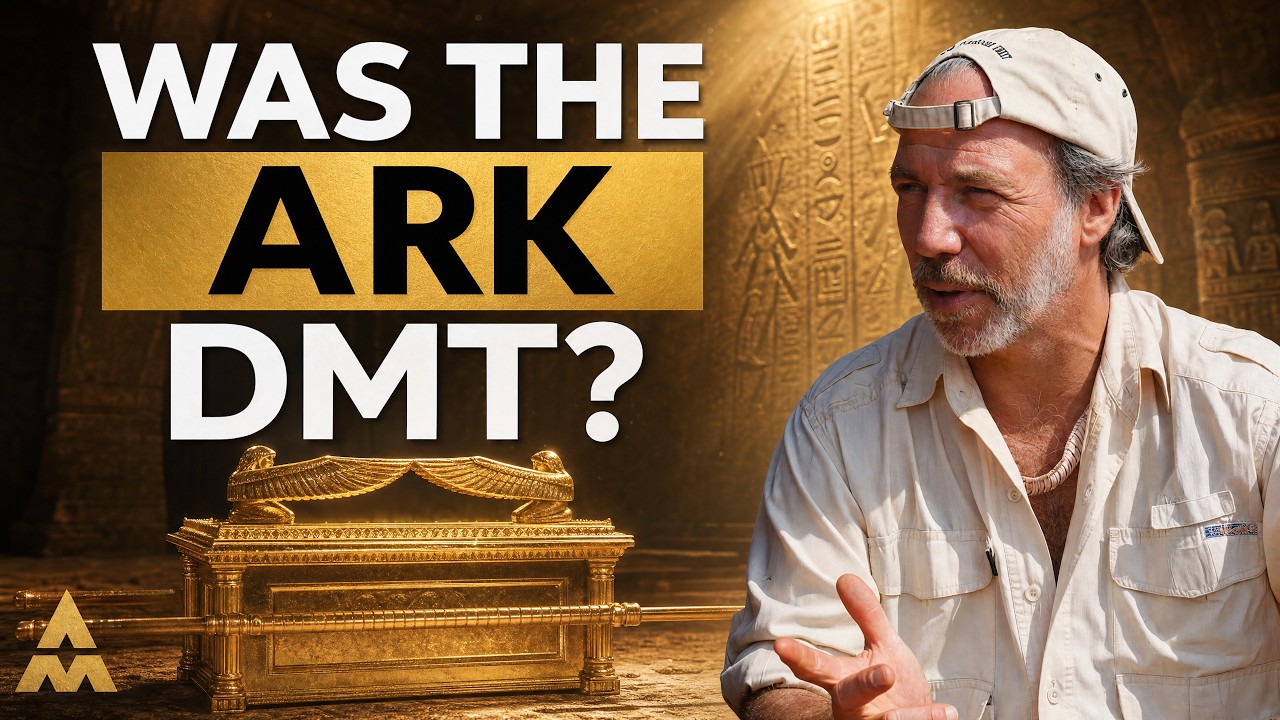
The Ark Of The Covenant, Secrets Of The Amazon, Shamanism, & Ethnobotany W/ Dr. Mark Plotkin
Watch on YouTubeVideo summary
Dr. Mark Plotkin introduces himself as an ethnobotanist dedicated to studying the intricate relationships between humans and plants across diverse ecosystems, arguing that nature possesses innate intelligence and that conserving shamanic cultures is essential before their wisdom vanishes like a book without an index. He explores theories regarding human cognitive evolution, comparing Terrence McKenna's "stoned ape" hypothesis involving magic mushrooms with his own theory on caffeine from coffee berries as the safest survival advantage against predators. Plotkin delves into indigenous realities where shamans navigate multi-dimensional worlds and engage in spiritual battles, contrasting these experiences with Western skepticism while citing examples of shamanic healing for conditions like epilepsy through non-verbal communication during ceremonies. He also addresses historical mysteries such as the Ark of the Covenant, suggesting it may have been crafted from *Acacia* containing DMT, implying that ancient religious texts and experiences could be influenced by psychoactive plants like Ayahuasca, Syrian Rue, or ergot fungus.
The discussion extends to clarifying misconceptions about animal behavior and historical usage, noting that while dolphins use pufferfish toxins medicinally, there is no proof jaguars consume Ayahuasca, nor was ancient Toad usage documented among the Aztecs despite frog iconography. Plotkin warns against "biopiracy" but acknowledges a growing trend of ethical collaboration with indigenous peoples, stressing that some plants are endangered while others can be cultivated elsewhere to reduce environmental strain. He highlights the dangers faced by inexperienced users who mishandle powerful medicines and advocates for respecting indigenous sovereignty over their knowledge systems. Furthermore, he touches upon synthetic alternatives as tools that support conservation efforts without compromising cultural preservation, urging a balance between protecting plant life and maintaining traditional practices.
Plotkin argues that artificial intelligence and natural human intelligence are not opposing forces but essential partners in solving global challenges, particularly in drug discovery where nature offers the best hope alongside technological aids. He suggests a resurgence of ancient wisdom is occurring as new technologies like LIDAR mapping confirm long-lost civilizations in Honduras and digital scanning reveals lost knowledge from charred scrolls found at Pompeii. A critical threat identified by Plotkin is consumerism driven by technology, such as cell phones, rather than the tools themselves; while providing GPS devices allows indigenous people to record oral traditions digitally and become "cyber shamans" who can earn income through ethno-botany without abandoning their heritage, economic pressures like needing SIM cards have unfortunately led some community members into prostitution in subsistence areas.
Ultimately, Plotkin emphasizes that non-violent approaches are effective for many but may not work against entrenched extremist beliefs or political violence, promoting the Amazon Conservation Team's model of "biocultural conservation" which empowers indigenous peoples to protect their ancestral lands and cultures simultaneously rather than treating them as separate causes. The organization highlights a utilitarian argument for rainforest preservation by noting that many common medicines like beta-blockers and ACE inhibitors originate from tropical nature without fair compensation to source countries, urging the public to support conservation efforts due to these direct benefits to human health and ethical responsibility. By combining technological advancement with respect for indigenous sovereignty, society can ensure both environmental sustainability and the continuation of vital cultural wisdom for future generations.
Read the full video transcript
Remember the ark of the covenant? You
remember what it's made from?
>> Aaca.
>> And what does aaca have in it?
>> DMT.
>> And I'm not arguing that the ten
commandments were written under the
influence of iawasa, but they could have
been.
>> I call myself an absolutist, which is a
person who studies the relationship
between people [music] and plants. Many
academics, they look at something, they
have their own theory, and they say
that's the way it was. I don't. And this
is your life's work. You've really dug
deep into plant [music] and human
interactions in a variety of different
ecosystems. One of the great mysteries
of ethnobbatany was the aliscinian
mysteries. [music] Much more recent
research has found jawbones with urgent
alkalines in them. The the ancient
Greeks were not only probably tripping
[music] their brains out, but it's been
hypothesized that that was the birth of
Christianity as well. Our friend Stamus
was in Egypt and he looked in some of
these temples and there's magic
mushrooms. This is probably the most
studied civilization of the ancient
world, Egypt. Right. We're still finding
new [ __ ]
>> Cuz nature has this innate intelligence
[music]
that's so important. And I think that is
also another big reason to really double
down on these conservation efforts. If
the forest disappears, we're losing
those shamanic [music]
cultures and wisdom. It's like, well,
here's a book, but there's no table of
contents and there's no index.
>> What are your thoughts on this kind of
boom [music] in artificial intelligence
and how this might unlock certain
elements of natural intelligence? Do you
have any, you know, kind of hypotheses
[music] about what's going on?
Mark, good to have you here.
>> Aubrey, good to be here.
Many of us have heard of the stone ape
theory which is positing that the
interaction with psychedelic mushrooms
in particular advanced our evolution and
our consciousness. You have a slightly
different theory that I don't think is
mutually exclusive may include both but
it's the Java man theory. Tell us about
that. Most of us haven't heard anything
about this. Well, it's totally exclusive
Aubrey. uh the stoned egg theory which
was put forward by our late friend
Terrence McKenna uh posited that when
humans prehumans came down from the
trees for whatever reason they saw these
mushrooms maybe they were following big
game and in the feces of the big game
these mushrooms were sprouting up these
are definitely dung loving mush
mushrooms and they're magic mushrooms so
that created cognition nobody's been
able to explain satisfactorily why the
prehuman brain became the human brain
about 300,000 years ago in terms of its
rapid growth in size. There's an equally
interesting theory called the drunken
monkey hypothesis which says that when
our ancestors came down from those
trees, they weren't looking for magic
mushrooms. They were looking for ripe
fruit because the ripest fruit falls to
the ground. And what happens to ripe
fruit when it falls from the ground? If
it doesn't get eaten, it fermentss and
creates alcohol. So that alcohol is what
caused cognition and uh social behavior
and and bonding. And then my theory I
call the mocha jaba man hypothesis which
is noting that we arose as a species in
east Africa mostly in and around the old
divide gorge. And at the northern edge
of that you have the original coffee
forest which is essentially what today
we refer to as southern Ethiopia. And
coffee berries are bright red. You can't
miss them. And they're kind of tasty and
they're full of caffeine. So I like to
compare theories by saying imagine three
promians running across the African
savannah being chased by a hungry lion.
One of them's tripping on magic
mushrooms. One is drunk on fermented
fruit and one is overcaffeinated on
these coffee berries. Which one do you
think is going to survive?
>> Well, let me tell you what happens. So,
the drunken one thinks they can ride the
lion and then they get eaten. And then
and then the the one on magic mushrooms
has a chance to maybe occasionally ride
a lion, but mostly gets eaten. And then
the ones with caffeine probably figure
some [ __ ] out and survive and procreate.
That's That's how the theory goes for
me.
>> I I I think your hypotheses are equally
valid. I think the emotional one might
try and levitate over the line
[laughter] and the drunk one might take
it on, but the caffeinated one is the
most likely one to get away.
>> Yeah. Yeah. That's super interesting.
And and this is your life's work, right?
I mean, you've really dug deep into
plant and human interactions in a
variety of different ecosystems, but
particularly the rainforest.
>> Well, I call myself an antinobotist,
which is a person who studies the
relationship between people and plants.
Everybody loves the idea of following
shamans through the Amazon rainforest.
I've done plenty of that. But the broad
uh explanation of ethnobbotany is people
and plants. That means farmers in a
cornfield. And of course, as as somebody
who knows and loves nature like you
obviously do, it's all connected. So
when you see a farmer in Iowa, he or she
may or may not be aware that corn
originated uh on the Mexico Guatemala
border. And even though we have high
growing, high yielding corn in Iowa and
everywhere else, that we still need
those wild and semi-domemesticated
varieties of corn in Mexico and
Guatemala to increase yields, increase
pest and diseases, and increase
resistance to uh climate stress.
>> Yeah, that makes total sense. You know,
one of the things that's been
particularly interesting for me in my
own Oh, man, how many years has it been?
uh 28 years of of work with the
psychedelic medicines is in going deep
with the shamans of the jungle
particularly the Iaskaros and the
kuranderos of the of the deep forest
they live in an entirely different
paradigm I mean their paradigm is
multi-dimensional and the things that
are happening in dreams in visions are
almost equal in importance to the things
that are happening in ordinary life and
they've according to what I've seen in
what they say. They navigate in an
entirely different world where
competition exists in the astral. You
know, battles can exist in the astral.
All of these things that we think are
are science fiction are just reality for
them. One of the indigenous groups I
work with and I did my thesis on many
decades ago were called the live on the
border between Cerninam, French Gana,
and Brazil in the northeast Amazon. And
they have a different theory of reality
and shamanism. Usually becoming a shaman
or a medicine man or a medicine woman in
most cultures even in our own to become
an herbalist involves learning and being
in the classroom or being in the forest.
The one say no we're born with a
invisible blindfold over our eyes and
being able to remove that blindfold is
the first step to becoming a shaman. And
I asked the shaman to explain it to me.
He says, "Well, imagine that at some
point in your life you saw somebody you
hadn't seen in 30 years and the night
before you had a dream about them and
there they are in front of you." Okay,
we've all had that experience. Now, we
call that a coincidence. They say, "No,
that's that's peing into a different
reality." as you said and again just to
tie it back to our own culture. If you
look at the Washington Post this
morning, there's a big article about a
doctor who is who is dealing with dying
patients and the visions they have. Now,
these are not the near-death experiences
that have been studied and and this is
something completely different. This is
before they die, they start revisiting
their childhood or having a conversation
with the stillborn child they had. I
mean, just totally amazing stuff. So
yeah, to circle back to your point,
there are other realities out there. I
do think that indigenous peoples are
more comfortable with them and we have a
lot learn to learn by listening to them.
>> Mhm. What are some of the things that
really surprised you as you've gone
along in the journey and kind of dove
deep into their own reality and the the
ontology of existence that they have?
>> Just their abilities to see things that
make no sense. Look, I'm a scientist.
I'm supposed to believe what I see. But
I think it was uh Carl Youngung who
said, I don't engage in the fallacy of
dismissing something just cuz I can't
explain it. And time and time again,
you'll have uh so-called primitive
peoples of preiterate peoples tell you
something which you may not believe,
which may not make sense and it turns
out to be true. Not always, but
consistently. And so that just to me and
my mentor uh Richard Schulty's the
Harvard ethnobbotnist would say listen
he say these naked primitive people know
a lot more about this stuff than not
only than what we do than what we ever c
ever can. So you know let's be
open-minded here. And so here's a
Harvard guy at the top of his game
talking about how much more they know
than he do. And this is not to to give
this sense of the noble savage that
chamins know everything that indigenous
peoples know everything. They don't. But
at the time, this was several decades
ago, it was all too common to dismiss
anything they said or did as oh well
that's just folklore and and ignorance
and things like that.
>> Yeah. In my experience in
[clears throat] working with different
Ketwa shamans and mystiso shamans,
Shapibo shamans, particularly the the
shamans from Peru, I can be utterly
blown away at their proficiency of both
navigating creating space to for a safe
space for us to navigate applying you
know kuras like the the right cure at
the right time with the right song and
just absolutely blown away. And then
we'll get into a consult in a group
setting and somebody will present some
some issue going on with their family
and then they'll delve into familial
advice and it's like whoa like this
we've we've advanced way beyond this in
our psychology. However, in our
spirituality you're you know your
absolute PhD and you're at a 101 level
of just basic psychology and both can
live at the same time. And I think
that's something also to recognize. It's
not that they know everything about
everything, but what they do know, they
can they know. I mean, they're swimming
in in waters so deep that, you know, we
can hardly see the creatures down there.
I mean, if we had a couple more hours, I
could tell you all the stories or maybe
a couple more days. I'll give you one
example just to tie into what you just
said. There was a a girl who suffered
from epilepsy. Uh suffered terribly. She
was seeing all the best doctors in the
US and Europe. They really weren't able
to give her any relief. It was so bad
she couldn't shower by herself because
she might go into a fit and fall down
and break her teeth or neck or
something. And uh one of the shamans
that I knew best was working very
closely at the time treated her and uh
afterwards I I said to her uh tell me
about a little bit about your epilepsy
if you don't mind. She says well when
you're an epileptic she says you don't
know that you're having a fit. You just
kind of fall asleep or you start seeing
things. For me, I would see three
young girls come out of my chest and
then they would walk to and and through
and into the wall. Okay. The day after
the ceremony, I said to the shaman, "Uh,
tell me about what you saw." Now, he
spoke only Spanish in his indigenous
language. She didn't speak a word of
Spanish, so there was no verbal
communication. He said, "It was really
hard because I had to pull three girls
out of her chest and make them go away
because that was the problem.
Now explain that to me scientifically
because I can't do it. But eventually
the the child got better.
>> Yeah. I mean I I've also seen and and
experienced not privately in my own
psyche a little bit but more just with
people in the groups that I've been with
that have been utterly profound. Now
when you press the question and you talk
about these three girls in the chest for
example maybe you didn't press this
particular line of questioning. What is
the belief that you find most common
about what are these entities like where
do they come from? What are they? What
are who who what are these three girls?
You know, I don't know. I that's really
not my area. I'm just accepting and
listening.
>> So, I I have no interest in trying to
become a corander, you know, or or
telling people I'm a shaman, which I'm
not. I never do. I'm not even earthless,
you know. Uh how how deep do you want to
go? And sometimes you get a sense like
that's their magic and they really don't
want to fork over the recipe or anything
anyhow. So sometimes it's better to, you
know, poke a little bit but not go too
deep.
>> Yeah, fair enough. So I think a lot of
us are familiar with Iawasco. We're
familiar with some of the, you know,
even combo, you know, we're familiar
with some of these that have traveled to
the west and many of us have experienced
them. But there's a whole host of other
different plants that are incredibly
significant that come from come from
nature and also animals and you know
different compounds and you've done
quite a bit of work studying those. So
if you could if you wouldn't mind just
kind of running us through some of these
discoveries that have come from us
looking listening and studying how
humans interact with nature.
>> Well let's go back to 1967. There was a
meeting in San Francisco called the
ethnofpharmacologic search for new
psychiatric drugs. And at this meeting
were all the superstars of ethnobbatney.
Gordon Wson the guy who did the seminal
work on the mushrooms Schulty some other
people of of that level of achievement.
And then when we did it again 50 years
later that wasn't at the first one. Uh
we talked a lot about Campbell the magic
frog. The point being that the greatest
minds in ethnobbotany who worked in the
rainforest for decades or maybe hundreds
of years if you looked at it
cumulatively didn't know anything about
magic frogs. Okay, that if you' said
that they would have thought you were
crazy or or you've been drinking too
much Iawaska in the meantime. The point
being is that we know what's out there
but we don't know everything that's out
there. And if you look at the diversity
um there's got to be more stuff out
there.
>> Okay. I uh I I'm sure you're familiar
with Paul Stamuts. He's he's on the
board of my organization, the advisory
board uh here at the Amazon Conservation
Team. And I was saying to him, okay, you
call uh you call psilocybin the Einstein
molecule cuz it's so brilliant at
helping humanity with so many things. Is
there another psilocybin out there? And
he smiled and he said, I can't say there
isn't. And then a few months ago, and
I'm sure you saw it, they found another
mushroom where you take it and you see
all these little people.
>> Okay, it's not psilocybin. It's not a
psilocyb mushroom. We don't know what
the hell it is or what's going on. And
so once again, we find something which
you do to ask the greatest scientists of
the age. They would have said, "No,
there's nothing like that. I know it's
an old wives tale." Except it wasn't. If
you uh my last book, the Amazon, what
everybody needs to know, I totaled up
the number of ad mixtures and IA is all
about ad mixtures. Here's what's
confusing about Iawaska. Iaska is a
vine, but you always need to use
something else with it or it really
doesn't pack a punch. Okay, so people
use psychotraverus, which is known
commonly as chuna, and that potentiate
the reaction. You just take either of
those two plants by themselves, you
don't see fireworks. All right? But in
going through the literature while
writing this book, I found there's over
a hundred different ad mixtures that
have been recorded.
>> Now, you can't tell me that every one of
those has the same effect. And so, even
the stuff that we know, there's more to
know that we don't know. And and I'll
give you another theory of mine. There
was a Israeli ethnobbotnist named Benny
Shannon. Benny Shannon died I think a
year ago. But Benny uh said, "You know,
I'm an old Jewish guy and I never
understood how a man could go into the
Sinai and talk to a burning bush." He
said, "And I went to Peru and I drank
Iawaska." And I said, "Now I understand
how a man can talk to a [laughter]
burning bush."
But there's no owa in the Sinai.
However, and this get a little
technical, not too much. When I was
first analyzed in the lab, they pulled
the alkaloid out and they called it
telepathy because as you know in the
ceremony you can communicate
telepathically with the shaman.
But further research revealed that
actually that alkaloid had been found
before not in Iawaska but in a plant
from the Sinai Syrian rue. So that was
half the uh half the Iawaska formula.
Okay. But where was the other half?
Well, I'm I'm I'm kind of a history
nerd. Um, remember the Ark of the
Covenant?
>> Of course.
>> You remember what it's made from?
>> Aaca.
>> Exactly. And what does Aaca have in it?
>> DMT.
>> So, there's your Iawaska recipe.
[laughter]
>> Yeah.
The the the point being, Aubrey, is that
I'm not arguing that the Ten
Commandments were written under the
influence of Iawaska, but they could
have been.
>> Okay? And that's what makes this
endlessly fascinating. Many academics,
they look at something, they have their
own theory, and they say, "That's the
way it was." I don't, you know, do I
think human cognition was created by
coffee berries? I do. and in part by uh
the magic mushrooms and in part by the
alcohol and the fermented fruits and in
part by the invention of fire and in
part by the invention of language. So
tying all of these threads together,
ethnobbotnists tend to be pretty good at
because we are interdisiplinary by
nature. You're not just a botist, you're
not just an anthropologist. You got to
combine a lot of different disciplines
>> and and that's why I I'm so excited when
I see some of these pieces of the puzzle
may fit together even if they don't
ultimately prove true. Now, nobody has
proven uh anything about uh these owas
alkaloids and the ten commandments but
uh who knows what the future will hold.
For example, one of the great mysteries
of ethnobbatany was the Eloisian
mysteries. Familiar with those? ancient
Greece. That was the right of passage.
That was the equivalent of Iaw Oscar
ceremony. Nobody could figure out. But
this controversial academic who was
right said, "I think it was alkaloids
from a fungus, from the urgot fungus."
And he was dismissed as a nut and a
radical. And then much more recent
research has found uh jawbones with
urgoids in them in ceremonial centers.
And so what that means is that the the
ancient Greeks, the mothers and fathers,
the civilization in which we live, were
not only probably tripping their brains
out. But it's been hypothesized that
that was the birth of Christianity as
well. That Christianity is not just an
offshoot of Judaism, but it's an
offshoot of these ancient Greek
religions where these guys were, you
know, doing doing fun
>> back. Yeah. And that I think the
psychedelic urgot it's it's kind of an
LSD analog right is what they what they
posit that uh that comes from that
particular fungus.
>> That's a that's a back it's a back
there's a backstory to that and it's
often confused. I I go into this quite a
bit. I have a a podcast called plants of
the gods hallucinogens healing culture
and conservation. And so I went into the
Harvard archives did the research.
Here's what the origins were. Um Albert
Hoffman was studying urgot and urgot
alkyoids. Now urgot alkaloids are used
for difficult child birth still used for
treatment of migraines and he said okay
let me didd the molecule. So you add a
side chain you cle something off and all
of a sudden you have a new wonder drug
or you have deadly or poison and so LSD
which is one of the new molecules he
came up with was the 25th molecule he
created based on the urgot model. So in
technical terms it's LSD25 and that's
fine.
>> Yeah, that's super interesting. And also
when you think about Iawaska
the the MAOI that it contains the
telepathine this thing that activates
the DMT when you mix it with Jakuna or
wombisa or opi or whatever is the high
DMT containing ad mixture.
>> None of these plants will have an effect
that's noticeable, you know, if you just
have them on their own. Now they have
spiritual technologies where they go
into what they call a dieta which I'm
sure you're familiar with where they
connect spiritually with the energy of
the plant and that's a whole different
technology. But if you just had a tea of
jakuna, you're not going to see visions,
you know. But so it's it's almost as if
not only are there so many plants that
we can sense and feel if we took them,
but maybe there's so many plants that
wouldn't even be activated unless we
were actually, you know, had some vine
or had some Syrian rue inside of us to
really potentiate the physical effects
that would be noticeable. So that just
opens the door for so many new
discoveries that may come down the pipe.
You know, if you look at the Amazon
pores, you got 30,000 to 80,000
flowering plants in there, depending on
whose estimate you accept. How do you
find one that's psychoactive? Now,
imagine the odds if if if they sent you
or me, they ran Amazon for us and said,
"Find two that'll do this because if
they're not combined, they don't." Okay.
So, uh the the the point being is that
this is just one of the great mysteries
and um who knows, you know, that's why
it's just so endlessly fascinating.
>> What do you think about the theory that
in order to discover the psychotropic
qualities of the iawaska vine that the
indigenous were watching jaguars kind of
gnaw at the bark of of and the of the
iwaska? Do you do you think that's an
accurate theory from what you've
studied? I wrote a book called Medicine
Quest and there's a chapter in there
called plants of the apes and the idea
came from my late good friend Jane
Goodall who was an adviser to the Amazon
conservation team and I was working on
the ethanol botney of wine the invention
of wine the effect of wine on human
culture western culture and uh she said
we were sitting around drinking scotch
which was her favorite drink and she
said I I was telling her about this and
she said well you know the the ancient
Greeks and the Roman didn't invent wine.
And I said, "Yeah, I'm a nerd. I did my
homework. It was invented by the ancient
Georgians who taught it to the Greeks."
She goes, "No." She said, "It was
invented by animals."
And I I I looked at and she said, "My
chimps like to get snuckered."
So she launched a whole branch of
biology that many people haven't heard
of called Zoharmaccognacy
that animals use plants for medicines.
Okay? and and she had a famous argument
with a another uh biologist where they
said, "Why do you give names to your
chimps? That's not scientific." And she
looked at the guy and said, "Do you have
a dog?" And the guy said, "Of course."
And she said, "Does your dog have a
personality?" And he said, "Oh, yeah,
absolutely." She says, "Well, my chimps
have as much personality as your dog,
maybe more."
>> The point being that we've all seen dogs
eat plants when they're sick. We've all
seen cats eat catnip and start tripping.
>> So why wouldn't animals uh eat plants?
However, to circle back to your your
question, as far as I'm concerned,
jaguars eating iwaska is an old wives
tale because people publish it. People
talk and I say, "Did you see it?" Like,
"No, but the Shaina's cousin's
daughter's friend's uh pal saw it." I
need a little better truth than this.
But to go back to our earlier point,
that doesn't mean I rule it out. But it
does mean that until somebody can show
me a a jaguar with iawasta in its
stomach or has observed a jaguar eating
iawasta, I'll say it remains to be
proven. So the answer to your question,
long answer for a short question is that
yes, uh animals do use plants medically.
Uh and and as it's shown in this in the
drunken monkey hypothesis, animals do
use plants to achieve altered states.
Jaguars and Iawasa
>> questionable.
>> Proof remains to be
>> questionable. Yes. I thought one of the
coolest stories about animals getting
high off of nature was the story about
the dolphins and the puffer fish and how
they, you know, they get a puffer fish
to secrete its poison and then they pass
it around like it's a like it's a giant,
you know, a giant joint. Yeah.
[laughter]
>> [gasps]
>> Uh yeah, my uh old friend Wayade Davis
uh did some work on the zombie poisons
in Haiti decades ago and his theory is
that this puffer fish poison is what you
know knocks people out without killing
them. So it's been widely accepted, not
universally accepted, but it's just
another indication that nature does
stuff that we don't yet understand. And
I'll give you a a concrete parallel.
There's a billion-dollar drug called
Taxol used for I think testicular
cancer. Comes from the Pacific Utri
except that it doesn't come from the
Pacific Utri. It comes from a fungus
that lives inside the Pacific Utri. So
imagine that. That's a billion dollar
drug. And it wasn't until decades after
marketing it, using it that we figured
out this doesn't come from a plant. It
comes from a fungus.
>> We are in unprecedented times. And the
first thing that arises is a need for
safety. How do I ensure my own safety
and sovereignty so I can protect myself
and my family and also contribute to a
better world? And so one of the things
that I think is really important is to
recognize where you are holding your
value. And right now a lot of us are
holding our value in cash. What is cash?
Cash is promises made in paper or
plastic from governments that we know we
can't trust. But what has real value?
Precious metals. And this is why I
created the mint metalmark.com.
Mtlmrk.com.
Precious metal currency. I believe it's
the future. It has real tangible value
and we're combining it with the
collectible value of incredible artists
like Frank Frisetta and many more to
come. So check that out at mtlmrk.com.
And furthermore, you need to make sure
that you're making the right best
decisions. And so you need to have the
maximum amount of energy, clarity,
drive, and focus. And so I encourage you
guys to check out correctlife.com with
the K. Correct edge is something I take
twice a day to make sure that I am
operating at the highest capacity that
Aubrey Marcus can operate at. and it's
actually the reason I founded that
company in the first place. So check it
out. There's some amazing formulations.
I really think it's going to make a
significant impact in your life and
those decisions you'll make from that
place will reap rewards that could last
for generations to come.
Lastly, I just want to say like I
understand the stress that everybody's
feeling in these uncertain times and
really focusing on financial sovereignty
is going to be a big part of my message
moving forward. I've had the blessing of
having taken a beautiful ride. Me and my
family are safe and well and we're able
to support those that we love. I want
you to be that person as well. So, I'm
going to be talking about that a lot
more. So, make sure you like and
subscribe to the channel and follow me
on social media, Aubrey Marcus. Thanks
for your attention. We're in this
together. All for one, one for all.
Let's go.
What is it that you think, you know,
when you when you zoom out a little bit,
what is it about can consciousness in
general and particularly in mammals that
we want to get high? like why why is
this a kind of universal desire for us
to alter our consciousness?
[snorts] Well, much of my thinking on
that was influenced by Andrew Wild, Andy
Wild EIL, who was a famous integrated
physician, one of the first MDs to go to
China and study acupuncta.
What a lot of people don't realize is he
had the same mentor I did. It was
Schulties and Andy did some very
thought-provoking books which are much
overlooked today even though they're
worth going back and reading where he
pointed out why do people like to get
high? Well, why do little kids spin in a
circle until they fall over? They're
getting high, right? They're altering
their consciousness.
>> So, there is something in our in our
mind or our genes or whatever that wants
us to get away from ourselves. And that
could be spinning in a circle till you
drop. That could be like a Sufi dancing
all night. That could be uh taking
Iawasa. It could be having a drink at
the bar, smoking a joint. It's it it's
just that human desire to escape. And um
I I I think anybody who's had out-of-
body experiences where you've been in a
a maloco long house or ceremony and you
look down and you see yourself lying
there in the hammock or you're in a
hospital and for whatever reason you
you're you're seeing your body from
outside.
>> It just gives you a different
perspective literally and I I think
that's part of it. You know, is there
more to life than what we see in front
of us every day? Of course there is.
That's what we were talking about
before.
>> Yeah. It's almost like we're
incarcerated in ordinary consciousness,
but there's a part of us that knows that
we're connected to something much much
more vast and much more interesting. And
so if we can break the break temporarily
break the walls of this cognitive
reducing valve, as Huxley would say,
then we can open up the blinds, then we
can catch a glimpse of a of a reality
that I think innately we know that we're
a part of. Now, of course, we can
convince ourselves that we're not. And I
think that's where you see all of the
extraction that exists in the world is
from people who are disconnected from
that sense of interbeing and that sense
of interconnectedness, which the plants
like Iawaska continually reemerge you in
that kind of field of consciousness.
Yeah, I I agree with with what you're
saying obviously. And I was asked once
by a journalist said, "Well, you've done
all these Iaska with all these paramount
shamans, you know. I mean, does that
doesn't that make you a shaman?" I'm
like, "I'm not a shame. I don't want to
be a shaman. I'd never tell anybody I'm
a shaman." I said, "Doing Iawaska with a
lot of indigenous masters, to me, it's
like you're driving by a house and the
house has a couple of windows open and
you're getting a glimpse of what's
really going on,
>> but you're not going to get into the
house. I don't care how much I you
have."
>> And I've actually had Sheamans tell some
white people to stop drinking so much IA
because they were overdoing it.
So this idea I mean I when I was in
college in the 70s I remember people
thinking like the more dope you smoke
the wiser you get it didn't turn out
that way. So this this this whole idea
that hallucins are the answer. Hallucins
are the panacea. The more you drink the
better it is for you. You know Michael
Pollen wrote in one of his books he says
part of the problem we see today is
everybody wants to go to the Amazon.
Everybody wants to drink Iawaska. And a
lot of people that are doing this are
mentally fragile
>> and that's why they're going because
western medicine is not meeting their
needs and solving their problem. But
some of these people are held together
by scotch tape and that's these are the
people that come apart and because a lot
of these shamans really aren't shamans,
you know, they're pretenders. Um that
these people come apart and they can't
put them back together. You know, uh,
our our mutual friend Tim Ferris told me
about some guy. He went down to Peru and
he wasn't ready for three years because
he kind of came apart.
>> Yeah. The discretion needed to to know
who you're going to sit with is it's
pretty intense, you know, because
there's two there's two perils. The Sila
and Sheribdus of this of this path is
one incompetence. They just can't
actually handle the force of the
medicine themselves and they can't hold
the space. and two is malice. And you
know, both of those can be deadly,
sometimes literally, but usually just
psychologically deadly. And it's really
important that they that they are not
neither incompetent or malicious
because,
>> you know, I've I've seen both and I've
experienced both. And fortunately, I've
been fine. And I've also felt what it
feels like to be with a real master, you
know, where they've earned the name
Maestro or earned the name Dawn. like
it's it's actually an appropriate title
rather than just the you know the the
flattery.
>> You know one of my formative experiences
when I was a little kid my mother took
me to see Fantasia and the end of
Fantasia is that cartoon called the
sorcerers apprentice
>> and if you remember the story where this
the sorcerer steps out and Mickey says I
can do this and he starts making more
rooms to sweep up and all of a sudden
they're out of control. I mean, in
partly in homage to that film, I
entitled my first book, Tales of
Bashaman's Apprentice.
>> And uh these are not powers to be trifle
with or disrespected or just assuming
that you know uh you went to for a
weekend and got naked in the hot tub and
took mushrooms, so you're now a mushroom
master, a maestro.
>> Yeah, you're not.
>> Yeah, that's that's a trap where a lot
of people fall in. I I knew somebody
who, you know, did a little bit of a
bogga and then started serving a bogga
with horrendous consequences, you know,
and and it's
>> we've all we've all got horror stories.
>> Let's talk about buffo for a moment
because this is a really interesting one
because a lot of people think that if
psychedelics have existed, psilocybin,
there's a stone ape theory. I mean,
we're talking tens of thousands of years
of potential human psilocybin
interaction. Iawaska unknown but
probably thousands of years Wuma
thousands of years at least you know in
Shaveen in ancient Peru and however far
back that civilization goes. So a lot of
these have a storied
>> history of use and then buffo is like
what 1960s
>> you know where we actually discover 5met
from this Colorado river toad.
Yes, I did a episode on plants the gods
with Hamilton Morris which is very good.
We went into this that you have these
people that are like these are neo
mythologies that they're saying well
obviously the ancient Aztecs were using
this cuz it's in Mexico you know but
there's no proof. I mean, of course, the
Peruvians, you know, they wrote stuff
down. The the Aztecs, when the Spaniards
came, stuff got rotten down got written
down. But there's no written evidence
that these buffos on the Arizona Mexico
border were used in ancient times. But
again, to refer back to an earlier
point, does it prove that they weren't
using it? No. But people can't be
saying, "Oh, of course they were because
there's no evidence." They can say it,
but there's no proof. However, uh some
have noted there's a lot of frog
iconography in some of these Central
American temples. So once again, you uh
you can't totally dismiss it, but you
need better proof. Just because you put
a picture of a frog on your temple or
your synagogue doesn't mean that you're
you're ingesting it for hallucinic
purposes. But also, a lot of things are
overlooked. For example, uh our friend
Stamus was in Egypt doing the gringo
trail and he looked in some of these
temples and there's magic mushrooms,
>> but everybody who looked at it was an
Egyptologist. They could barely tell a
palm tree from a pine tree. So, they
didn't know these were hallucinic
species, but you can be damn sure.
>> I was actually on that trip with Paul
when he was going. He was so excited. He
was just going and he was pointing out
all the mushrooms and the hieroglyphs
and the carvings and it was it was cool
to watch him just find and see, you
know, clear and and he would show us,
you know, in the group. It was a large
group, but he would show us and be like,
"Yeah, yeah, those are still simon
mushrooms for sure."
>> Well, I'm jealous on that trip.
>> It was wild. It was wild.
But as you said, to pull the lens back,
this is probably the most studied
civilization of the ancient world,
Egypt, right? It's the mummy. It's
raiders of the lost ark. Uh, everybody's
seen pictures of the pyramids. We're
still finding new [ __ ]
>> Okay. So, how cool is that? So imagine
in a place the size of the Amazon which
is close to the size of the continental
US uh many species not only not studied
but not even named by scientists.
Imagine how much is out there to be
learned.
>> Yeah. An immense amount. And I I think
this ties into also one of your other,
you know, main points that you hit is
that the when we cut down a rainforest,
it's not just about, you know, the
carbon sequestering we're missing out
on. It's not just about the the oxygen
that they're producing. Yes, it is, you
know, the lungs of our planet along with
our oceans which produce a lot of the
the oxygen, etc. That's all important
from a macro standpoint, but who knows
what species we're causing to go
extinct. That could be the act absolute
key for us to make this kind of perilous
transition as we transition from an old
extractive story into a new one that's
sustainable. like we I don't think we
give enough
seriousness and and credit to the fact
that when something goes extinct, maybe
it's just a cute animal that we wish
existed like the dodo bird, but maybe
the dodo bird has a has a might on it
that has a has something in it that is
absolutely essential for humanity
because nature has this innate
intelligence that's so important. And I
think that is also another big reason to
really double down on these conservation
efforts.
>> Well, I I I want to add something what
you're saying. I mean, I of course agree
with everything you're saying, although
you said as we transition to a
sustainable future, I want to add as we
hopefully transition to a sustainable
future. And the other thing I want to
add is that yes, if the forest
disappears, and I'm not just talking
about the Amazon where I work, I mean
the boreal forest, any forest or any
coral reefs, what are we losing? But in
the rainforest, we're losing those
shamanic cultures and wisdom, which
means that we're losing the knowledge.
It's like, well, here's a book, but um
there's no table of contents and there's
no index. There was, but we threw it
away.
So when I have argued in the past with
missionaries forcing people to accept
western religion, I say uh you know I
don't care if these Christians if these
Indians become Christians and Muslims
are Jews, but it should be their choice.
It shouldn't be told, you know, come to
church and you'll get antibiotics and
rice. That's what I have a problem with.
And this this wisdom disappears much
faster than these for us. So I I want to
say both. Ironically, let me let me say
that this is ultimately a guilty
exercise because I think it's good for
all of us, but it should be done in a
way which is best for the indigenous
peoples themselves. A lot of people
don't get that and that it's up to them
if they want to share this wisdom with
us. Sometimes they don't, sometimes they
do.
>> And so this whole idea that the
rainforest is teaming with these eagle
ethnobbotnist biopirates, it's not true.
I've never met anybody from a
pharmaceutical company in the Amazon in
42 years. Never. So, I wish the
pharmaceutical companies were more
interested as long as they did things in
an ethical way, which certainly wasn't
the deep history, but it's becoming much
more common place as people realize
there's an ethical angle. I mean, you
look at you look at psilocybin or or or
IASKA. What what's that worth, right? I
mean in the number of the demand uh
couldn't a little bit of that go to the
indigenous peoples who taught us those
things and nurtured those mushrooms
through the conquest for 500 years
afterwards to make sure that that
knowledge didn't disappear. And another
point I want to make about these things
is some of this stuff's really in
danger. I mean is an ugly little tiny
slow growing cactus and some of the
indigenous peoples have trouble finding
enough for the rituals because a bunch
of you know so-called psychonauts are
going there and pull it out by the
roots. On the other hand, Iawaska is
kind of a weed. I mean, it it grows well
in a lot of places. I've seen it all
over in Hawaii. So, the the people
oversold this like, oh my god, I was
going extinct. Well, not that they're
growing in an Istanbul and Israel and
Indonesia and Berkeley, right? Species
aren't going extinct. There may be
varieties on that are lost if the porest
is cut down and we should be concerned
about that as well.
>> Totally. And you know, I think certain
plants have are just we have to take
more care. And also, you know, there's
certain plants that lend themselves to
synthetics a little bit easier. You
know, I mean, that's one of the things
there was just a recent study published
this month about uh synthetic 5me in a
single day treatment of three escalating
doses for women with postpartum
depression. And they they erased it.
They moved from a 37 on the MADRS scale
of postpartum depression to two in it
eight days later
>> and it three of them were suicidal and
it's it's gone like erased it and it was
a synthetic molecule and I understand
you know my fellow psychonauts when I
posted about that like oh but it's not
the same. And I'm like, "Yeah, but it's
okay." Like, "Well, let's let's let the
toads chill for a little while." And if
you don't need if you don't need it, you
know, like it's it's helpful. And same
with, you know, same with ibain. And boa
is a very slow growing tree shrub, you
know, and so it's I'm grateful that
these synthetics have been developed so
that we can actually meet the demand
without really stressing the
environment. And we should also take the
time to make sure we're replanting and
supporting the cultures that have tended
these particularly sacred gardens for so
long.
>> You know, if you make that into a bumper
sticker, let the toad chill [laughter]
by the first.
>> That's what they want to do. They're
chilling for nine months out of the year
anyways. You know, they don't want to
just come out and get squeezed
immediately. [laughter]
>> Yeah.
>> Agreed. Well, this is, you know, there's
so much that's possible and I I think,
as you said, hopefully we make this
transition into the next story. And I
think these plants, they all they all
have a role. These are all the the kind
of assisting cast. These are this is the
this is the cast of characters. It's not
just the people, but it's also the
plants. And I think the intelligence
that's working through all of us that's
going to give us the best shot, you
know, and who knows about how what are
your thoughts on this kind of boom in
artificial intelligence and how this
might unlock certain elements of natural
intelligence? Do you have any, you know,
kind of hypotheses about what's going
on?
>> I do. I got in an argument with a very
famous London surgeon uh a couple of
months back who said that we're facing
this terrible crisis of drugreser which
we are and the best hope was artificial
intelligence and I said absolutely not
the best hope is hi and he said what
does that mean I don't know the term I
said it's human intelligence I said AI
is a tool and like most tools if not all
tools it can help or it can hurt So, our
use of AI is going to determine uh how
beneficial it's going to be. Do I want
to rely on a on AI for new drugs and not
look at nature? No. Do I want to ignore
AI and some of the great finds that are
coming out? No. That would be equally
stupid. You know, it's it's not the
microchip versus the medicine man. It's
the two working together. And that's
what a lot of people don't seem to get.
It's like there's so much excitement
around AI. There's so much fear around
AI. It's like this is going to solve all
the world's problems or this is right
out of the Terminator and it's going to
kill all of us. Yeah,
>> I think it's somewhere in
[clears throat] between.
>> It it also seems like old wisdom and and
forgotten things are starting to come
into our consciousness. You know, I
think Graham Hancock's done a lot of
work to kind of expand our minds to
ancient history, but also recently so
much has been discovered underground
structures in the pyramids, things that
it almost feels like a lot of buried
intelligence is now starting to surface.
And who knows even about the this whole
disclosure movement that's happening.
It's like a lot of things that people
have been like, "Oh, no, dismissed are
now [sighs]
kind of kind of rising when we need
them. when we need different ways of
thinking.
>> I'll give you a personal example that
supports what you're saying. I was
contacted by two filmmakers who said,
"We found an entirely new civilization
in Central America." And I said, "Great.
Congratulations."
And and they said, "No, really?" And I'm
like, "Yeah, yeah, yeah. You know, I saw
Raiders the Lost Arc. I know you you're
finding new stuff. Big deal." And they
said, "Hold on a second." And they
unrolled these maps. So about 10 years
ago, they had liedard the rainforest of
southern Honduras where people had been
reporting an ancient civilization for
500 years and nobody had been able to
find it and they were through temples
which you could see clearly with LAR
which you couldn't see with radar. It
took us 15 minutes when we landed by
helicopter. Okay. So this is where new
technology married to this ancient
wisdom is the sweet spot. So this whole
idea that uh all we need is technology
or all we need to do is follow the force
right uh it's the combination of the two
which I think provides the greatest
promise for the future.
>> I'm with you. I'm with you. And you talk
about I mean one of the one of the
phrases that uses the burning library,
you know, talking about the talking
about the forest, but then I also think
about the actual burned library of
Alexandria, right? Like what did we lose
from that deep gnostic, you know, the
telsti and the hereticos and all of
these different mystery schools that had
encoded their wisdom, the Egyptian
mystery schools, everything that had
been collected there. I mean, we might
be in a totally different spot if we'd
had that wisdom. Well, the manifestation
of of what you're saying is Pompei
because they're now excavating the final
20% of Pompei, much of which was, you
know, raped and ruined by these stupid
treasure hunters 300 years ago. But
they're finding these papier, which
can't be unrolled. They're charred,
right? And they're 2,000 years old. And
they're using technology to be able to
digitally digitally un unscroll them
>> and then read them. even if you couldn't
read if you did. So maybe there's some
of this info from the lost library of
Alexandria in there or maybe there's
other finds. We're using technology. We
have access to it. If not, so this is
not to say, "Well, don't worry about the
library. We'll find it somewhere." My
mentor Schulties was working in the
Amazon for over a decade and he had this
nemesis who was this old fundamentalist
missionary and she goes, "I don't know
why you're wasting your time writing
down all this stupid Indian stuff." you
know, when when when Jesus returns to
Earth, all will be revealed. And Schulty
said, "I don't want to wait." [laughter]
>> Yeah. Yeah. People have been waiting for
that for 2,000 years. Hasn't happened
yet.
>> Yeah. Exactly.
So um you know it's a very exciting time
because these technologies make the
ancient world or the the preiterate
world more accessible than ever before
at but at the same time we're burning
down the library and essentially burning
down the librarians uh when these
cultures disappear. So it's not a
question of just losing nature it's a
question of losing nature which goes
right back to the library of Alexander.
>> Yeah. You know, it's there's so many
forces that are kind of
difficult and and harmful to indigenous
wisdom, but I think probably
the most harmful is cell phones, blue
jeans, Nikes, you know, like these
things, the the allurement of the kind
of consumerrist,
many would call it this consumerism
virus, you know, when you talk to
certain indigenous people who kind of
see it because it's it's steering a lot
of people from staying in the
traditional ways where often, you know,
grandfather to grandson, grandmother to
granddaughter, sometimes, you know,
mother to mother to son, father to son,
often skipping a generation, but there's
just they're looking out at and they
know people and they got shiny new [ __ ]
and a new TV and they're like, well,
this old way is not going to get me
those things, but they don't realize the
prize that they actually have access to.
And so I think that's another major
problem is and that's that one's even
harder to control because you can carve
out a plot of land and preserve it, but
how do you keep the infiltration of this
kind of western idea of more is better,
shinier is more alluring?
Well, there's several answers to that
question. One is we're an inquisitive
species. We like new toys. Okay, that's
not just us. That's everybody.
But the problem is when these
technologies sweep in, they're usually
introduced by people who are not
interested in doing that in a way to
help protect the culture. We at the
Amazon conservation team do ethnographic
mapping, which is we train the
indigenous peoples to map their lands.
And to be able to do that, they need
GPS's and they need walkietalkies. So
we're introducing this in a way which uh
helps protect the culture because they
got to go to grandfather and ask for the
old hunting legends. They go to grandma
and ask why is this these falls got such
and such a name? So instead of them just
looking at dirty pictures um they are
recording their culture as they go from
preiterate to literate
>> and that's been quite successful. A
colleague of mine says you're creating
cyber shamments.
>> Okay. But uh the the the side to that
that's that's very positive is I started
a program decades ago called the shame's
apprentice. I realized that I could not
write down all the stuff the shamans
were teaching me even if they taught me
everything which they wouldn't but they
would teach their sons and grandsons and
daughters and granddaughters.
So I actually gave little scholarships
to the kids and to the shamans to make
this transition happen. Well, lo and
behold, after a couple years, the young
guys know these plants. And when they go
to town, they've got plants to sell.
They've got medicines to sell. They know
how to do Olympia, a cleaning, a
training, a a treatment. And so
ethnobbotany is giving them jobs and
putting money in their pocket, which
means they'll have to go to the
goldfields.
>> Okay. So the but the flip side of that
is one of the great chains of the Amazon
complained one time to me about a decade
ago. He says, you know, cell phones are
here and they're here to stay. But here
you need a SIM card to use a cell phone
and we don't have a cash economy. We
we're subsistence guys. We hunt, we
fish, and uh some of the girls have had
to go to town and prostitute themselves
to get the money for the SIM cards
because it's the only way they can make
money. And so when people tell me
technology is better and we're all going
to live better through technology,
[ __ ]
>> You know, some of us will and some of us
won't. And and if you do it with your
eyes open, it's much easier to help
steer it than to just throw up your
hands and say there's no stopping it or
or or or trying to keep technology away
from these people as if they're in a zoo
and you have the right to to decide what
they get and what they don't. I feel a
tension within me as you know I've again
it's been 28 years I've been on the
plant medicine path and time and again
it shows me the interconnectedness of
all life that every single person is me
living a different life that we're all
originating from that same source call
it capital L life if you want and
then you look at you know we have
borders we have towns we have families
we have all of these circles and these
circles of of what we count and what we
what we care about. The first circle
around our self, the second circle
around our family, and then around our
nation, and then maybe around humanity,
separate from the rest of of
[sighs and gasps]
>> of the world and in the cosmos. But then
it's like
you see things happening in other
countries and and you realize, all
right, what is our responsibility? And I
really what I'm getting to is is like at
what point are we do we take
responsibility for the whole and at what
point do we and this is an open
question. I don't have an answer to
this. At what point do we just focus on
what's important for us and how do we
strike that balance you know when we see
these terrible things happening and we
see these needs that exist in other
people but then we can't you know do we
have a responsibility or do we not? What
what are your thoughts?
You know, I'm a pacifist at heart, but
understand that violence is sometimes
necessary. A colleague of mine says,
"Okay, look at Gandhi, one of the most
saintly spiritual figures in in the
history of civilization, and he
organized all of this nonviolent stuff
against the Brits and he won." Okay. Uh
I'm I'm a native Southerner. I grew up
in Louisiana. This nonviolent protest
really changed things. That was great.
But would that have worked if if Gandhi
was facing the Nazis,
right? No, it wouldn't have. So the this
whole idea like everybody should drink
iawaska and and we'll all do kumbaya.
Somebody sent me a a website really
quite frightening called uh Lucy in the
sky with Nazis.
The point being that some of these
hardcore right-wing groups are using
Iawaska and psilocybin to reinforce
these ugly views. All right. So, this
whole idea that well, let's expand our
consciousness and everybody just drink
uh drink the brew, we'd all be happy
happy and live happily ever after. You
know, there's something to that, but
it's not true across the board. There's
some people that just can't be rationed
with uh uh uh it it just doesn't work
that way. You know, hardcore beliefs are
very hard to change. And one of the ways
that I go about it, I mean, you you
communicate for a living is is trying to
explain to people the importance of what
we have uh that's come to us from
nature. For example, uh beta blockers
were basically built designed on the
chemical structure of the psilocybin
mushroom. Okay, it's a multi-billion
dollar industry that Albert Hoffman
started with Viscan, the first beta
blocker. I have never met a physician
ever who knew that beta blockers
originated from those magic mushrooms,
ACE inhibitors, billion dollar drug
based on uh venom from a Brazilian
snake. never met a physician who knew
that. Again, a billion-dollar drug. Now,
the the the sad part of this tale is the
Brazilians and the Mexicans never got a
nickel of that. So, that's not
acceptable. But these are powerful
arguments because everybody my age is
either taking ACE inhibitors or beta
blockers or both. Uh that to to let
these people know how much longer and
better you're living because of these
drugs that come to us from nature, in
this case, tropical nature. And we need
to convey that better than we're
obviously doing.
>> Yeah. How can people support? How can
people help?
>> Well, the Amazon Conservation Team,
which I'm the co-founder and the
president of, has been described as the
greatest rainforest conservation
organization that nobody's ever heard
of. [laughter]
It's because we put all of our money
into the field rather than direct mail.
Yuck. Or telemarketing. Yuck. Uh we just
do the work. We're on the web at
amazon.org. You can search under my
name, Mark Clark, and learn more. But
the focus is on on is on action. What we
do is not conservation. It's bioultural
conservation. It's working in
partnership with indigenous peoples,
first and foremost, ashamements, male
and female, to empower them to protect
their culture and their forest, which
they see as uh inextricable. When I
started out in conservation, I was
working for the World Wildlife Fund. It
was all about saving the forest, saving
the rhinos, saving the whales. Great.
Um, but they had nothing to do with
indigenous peoples. And then there were
groups like Cultural Survival, Survival
International. They were all about
saving the indigenous peoples, but they
had nothing to do with ecosystem
conservation. Uh we were the first
organization set up 30 years ago this
year to focus on indigenous lands,
indigenous peoples, not doing it or
telling them what to do, but trying to
empower them, train them um in ways that
they could take control of their own
cultural and environmental destiny. And
you know, we've got priority projects
need funding. You know, we know we do.
We have a successful methodology. We are
working with over 100 indigenous groups
in Amazonas
uh to protect over 100 million acres of
ancestral rainforest. And it's been so
successful that indigenous peoples
outside the Amazon like the famous
Kogis, the most spiritual people in the
hemisphere, uh have asked us to work
with them. We're working closely with
them for 10 years. The indigenous
peoples are helping us, asking our help
to protect coastal resources, protect
sea turtles all the way up Costa Rica
and possibly as far north as Waka. So,
it's not like, wouldn't it be great if
we tried this crazy approach? It's like,
no, we're doing it. And once you've done
it, you've done this successful. We've
running the longest indigenous park
ranger program in the entire Amazon for
20 years. That's proof of concept.
That's not showing up in an indigenous
village in the Congo or the Amazon,
having all the guys put on your t-shirt,
taking a picture, and say, "Look, we're
partnering with with the Pikmis." You
know, it's for real. The record is
there. We were the first environmental
organization to win the Skull Award,
>> and Jeff Skull knows a lot about
entrepreneurship. We were the first
social entrepreneur group in the
environmental field. He chose to give
the award to.
>> Well, that's incredible. and uh and I'll
definitely keep that in mind personally
and I just encourage the listeners
who've been moved by this to support as
well. So yeah, we'll be in touch. I'd
love to I'd love to be a supporter of
the project.
>> You know, I mean I'm here because you're
such a good communicator and you have
such a loyal following. [snorts] You're
you're magnifying our message. I mean
the message I'm bringing is from the
shamans themselves. I don't speak for
them. I mean much of what I'm telling
you I learned from them. But we need
help in getting this message out so
people know what's in it for them. I
mean, it's like a friend of mine says,
"If you want to do conservation, your
first question is, who gives a [ __ ]
right? Why should I care? Look at all
the problems we have in this country,
healthc care costs spiraling, stupid
tariffs, things like this, farmers going
out of business. Why should I care about
the Amazon?" Well, if you eat corn or
potatoes or avocados or smoked tobacco
or light chocolate or like vanilla, uh
that on your table is stuff that's
connected to the well-being of the
rainforest and those indigenous farmers
that are planting those things and
keeping them going. So, this is what
people need to know. This isn't some
sort of, you know, fun exercise. It's
about life on Earth. And I I I think
that conservation is first and foremost
an ethical exercise. Okay? It's the
right thing to do. Not because you make
money at it. It's because it's the right
thing to do ethically. Uh the people
that saved the Endangered Species Act
decades ago when the evil N Gingrich
tried to uh destroy it were
fundamentalists. We're evangelists who
showed up on Capitol Hill with placard
saying species. God made them. We
protect them. So conservation can make
strange bedfellows. But I think the
utilitarian case, who gives a [ __ ]
what's in it for me, is in fact more
compelling to most people.
And so as an ethaninobotist, it's easier
to make the case than saying, "Oh, we we
should protect the snail daughter just
because we should, which I think we
should, but to say, look, potential new
medicines for cancer, potential new
medicines for the next pandemic, which
is undoubtedly coming, better treatments
for current diseases like uh postpartum
depression. You know, it's the old and
the new and what's still out there."
that that to me makes this endlessly
fascinating and and and endlessly
sailable. [snorts]
>> So it is, you know, we got to do this
and and there's a shot clock. You know,
we got to we got to get our [ __ ]
together sooner than later here. I think
that's the that's the message. And I
think there's a lot of forces of
benevolence that are here to support us
in our efforts, but we have to be open
to them and we have to actually, you
know, lend our shoulder to the plow and
and actually get to work. So, I
appreciate you for doing exactly that
and uh and doing the good work.
We're all in this together, Aubrey.
>> Amen. So, we are. Thank you so much,
Mark. I really appreciated this.
>> I much enjoyed it. The hour went by
fast.
>> It did indeed. Did indeed. All right. We
love you guys. We'll see you next week.