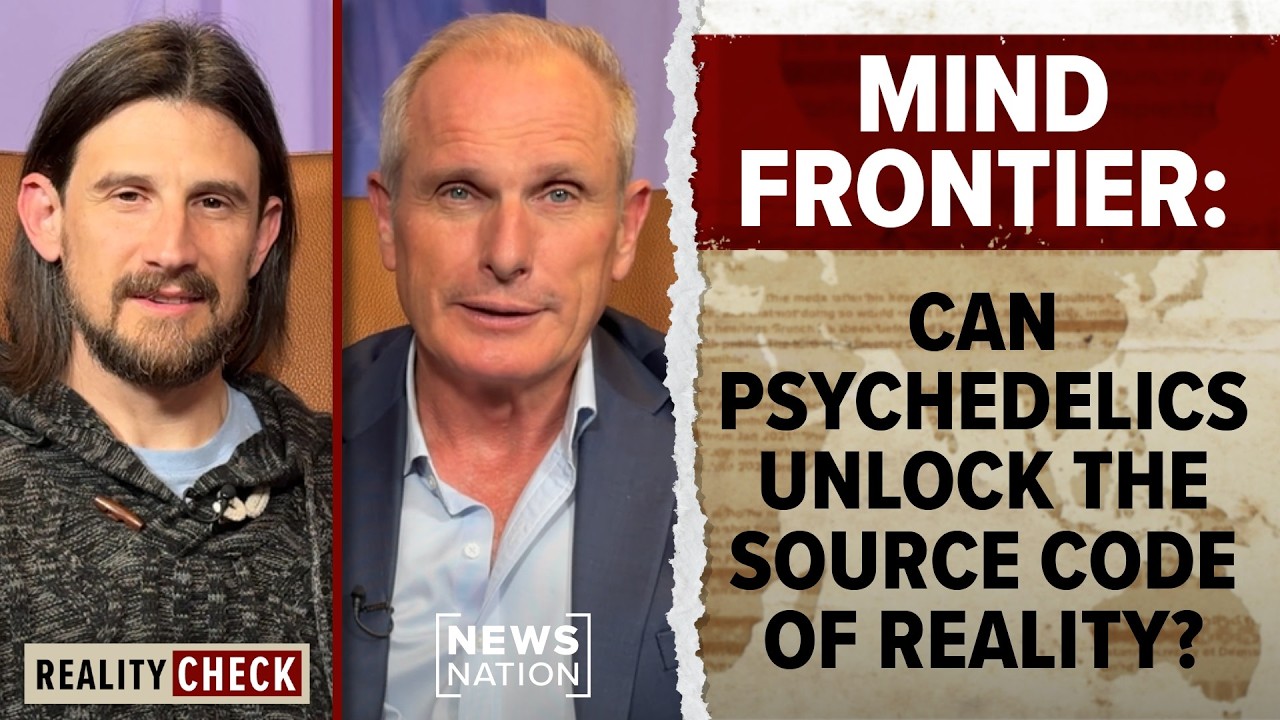
Researcher suggests use of psychedelic DMT can unlock hidden subconscious realities | Reality Check
Watch on YouTubeVideo summary
Danny Goler, an independent researcher and founder of Code of Reality, proposes that the psychedelic compound DMT can serve as a key to accessing structured realities beyond ordinary perception. Unlike typical hallucinations which vary from person to person, Goler claims that under the influence of DMT, users observe identical laser diffraction patterns containing coherent symbols or "source code." He argues that this consistency across different individuals suggests these phenomena are not merely brain-generated pareidolia but an objective reality accessible through consciousness. This experience is described as a shift in location within awareness rather than simply getting high, where intelligent entities identify the human realm as a simulation and offer perspectives from other dimensions or the future.
Goler theorizes that this phenomenon connects to the holographic principle in physics, suggesting that human experience projects data from a two-dimensional field into our perceived three-dimensional world. He posits that DMT allows access to a "light field" containing pre-rendered information before it manifests as physical reality. While acknowledging societal stigma and legal barriers regarding psychedelics, he maintains that his work aims to bridge quantum mechanics, consciousness studies, and linguistics by scientifically verifying these observations. He contrasts the alien-like perspective of DMT with Ayahuasca, which he views as more visceral and human-centric, emphasizing that current scientific limitations often dismiss such anomalous findings because they rely solely on measurable devices rather than validated inner experiences like meditation or remote viewing.
Despite official denials regarding government programs like Stargate, Goler notes significant interest from certain figures in the consciousness research community who have been impressed by his results. He highlights reports from professionals, including lawyers and doctors, who experience similar phenomena such as seeing machinery or menus during altered states but remain silent due to fear of professional repercussions. While admitting that meditation is often difficult for him personally compared to others, he cites physicist Richard Feynman's success with isolation tanks and mental training as evidence that these non-local experiences are achievable without chemical enhancements. Goler advocates for a mature approach to science that integrates human observation and brain studies into the definition of reality, aiming to present conclusive results within a year that could engage mainstream scientific discourse.
Read the full video transcript
Welcome back to Reality Check. I'm your
host, Ross Coulthart, and today I'm
delighted to introduce here at the
Conscious Life Expo in Los Angeles,
Danny Goler. Somebody I've wanted to
talk to for a very long time. Danny's an
independent researcher and inventor
known for his unconventional
explorations at the intersection of
physics, psychedelics, and linguistics.
His most publicized claims centers
around 2020.
While under the influence of DMT,
dimethyltryptamine, a potent
psychedelic, he alleges he discovered a
hidden language by viewing the smoke or
vapor through a focused laser beam.
Specifically, he describes inhaling DMT
vapor and shining a low-powered red
laser through it, revealing intricate
dynamic patterns that resemble a
structured script or glyphs.
He claims these aren't mere
hallucinations, but an objective
language of reality, a universal code
embedded in the fabric of existence,
potentially linking quantum mechanics,
consciousness, and ancient scripts like
Hebrew or Sanskrit.
And you also run a nonprofit called Code
of Reality.
>> That's what we call it done in cheek,
but you know.
>> So, you look like a a perfectly normal
person for a chap who's basically
inhaled a hell of a lot of psychedelic
drugs.
>> Yeah.
>> Um, is DMT dangerous?
>> Uh, uh,
Aldous Huxley used to say if uh,
you feared death by astonishment.
>> Yeah.
>> It's funny, I've used DMT myself, which
is half the reason why I really want to
speak to you. For me it was
life-changing. It was profound. And I
found
it it taught me things and helped me
understand things in the months after I
took it the first time. Do you find that
yourself?
>> Yeah, but I I think that it depends on
how deep you go and how well you
integrate it, but overall, yes,
absolutely.
>> So, tell me about this experiment. How
did you discover it?
>> Well, it's a it's a very long story, but
the short version of it is that I was I
had a set I had a set of experiences on
DMT that was, and it's going to sound
weird, out of the norm even for DMT. So,
it was as realistic as you are sitting
to next to me right now.
And [snorts]
that sets of experiences
made me
no longer comfortable with the idea that
this is just a mere hallucination or
something in my head. And I asked
myself, "Okay, well, if the if whatever
we're experiencing on DMT might be real,
as in existing on its own side even when
we're not looking,
then how we can we potentially determine
that conclusively?"
And when I looked around, I realized
that the answers that I I I saw from the
scientific side and from the spiritual
side were simply non-satisfactory to me.
So, I decided that what I'm going to do
is I'm going to try and answer that
question myself.
And that started a very long process of
years in which I was trying to think
about it in every which way, try to make
some fundamental assumptions about what
we what must be true if this space is
real. And eventually, after years, I
think after maybe
5 to 7 years from that point,
I realized that coherent light is
supposed to be doing something when
we're observing psychedelic spaces.
And sure enough, I turned on a laser,
and has to be diffracted,
and I smoked DMT
>> So, you're putting it through a prism.
>> Uh it's not a prism. Uh that would be
refraction, so that that's diffraction.
So, it basically splits the light into
just like you have the the double slit
experiment, only many many many slits.
So, essentially creates a band of light
on the wall.
And when you look at that while you're
on DMT, you see
what I observed and now thousands of
people all over the earth observe so
far,
there seems to be some kind of language
in there, but it's not appearing in the
same way that people tend to see
language in psychedelic spaces or in
meditative spaces. It seems to be more
coherent, super HD, and it it's
suspended in its own space in some way.
So, it's doing a thing on its own
accord. It's very similar to how you
look through a microscope.
>> Yeah.
>> There's a whole world in there that
you're exploring.
>> So, what is it? I mean, I I think the
the skeptical explanation for your
observations
argues that it's essentially an intense
visual hallucination. And this is what
orthodox science says.
>> Yeah. They say that by binding to
serotonin receptors in the brain, it
produces geometric patterns and entity
encounters.
And the laser beam, they speculate,
could amplify pareidolia, the tendency
to see meaningful shapes in random
stimuli.
>> Yeah.
>> [snorts]
>> Through light diffraction in the vapor,
creating optical illusions akin to laser
speckle patterns in physics demos. And
as I'm saying this, it's not really
washing to me because it's not a laser
speckle pattern. You're seeing a very
formed language, aren't
>> And you can say that the speckle can
work as as a form of scaffolding for the
mind to basically attach content to,
which does make sense. But the way to
question whether it can So, the question
whether the brain can somehow produce
this under the influence of DMT with
with coupled with the with the fractal
laser, that's not a good question
because the answer to that will always
be yes. Simple It doesn't matter what
you do. The answer is yes.
>> I read a book by Rick Strassman called
The Spirit Molecule, which is
fascinating. And he, of course, was a
psychedelics researcher as well.
And he also documented not just
entity encounters, the machine elves,
but this weird geometric visions, a
shared phenomenological space, which
sounds very similar to what you've seen.
>> Yeah. And I think that that is actually
the deeper question, which is does the
DMT space itself
uh is something we hallucinate or we
actually see, which is the question that
I started with. What the laser allows us
to do is to have a repeatable experience
across individuals.
>> Which is a perfect example of good
orthodox science in many ways, isn't it?
>> Yeah. And and it doesn't it does have
this uh
really there kind of quality. It's hard
to describe, but even when you
quote-unquote hallucinate,
hallucinations have a trajectory. They
evolve. They change. They change across
people. Even if people report similar
things, they they don't always agree on
exactly what they're saying. In the case
of the laser and what you see in it, at
least to the
to to to date, it seems like what
everybody's seeing is the the exact same
thing. We can even point to the same
thing.
>> what I don't understand because
you're seeing
literally a language, a symbology,
through the refracted laser beam
with DMT smoke in the middle.
>> No, no, not necessarily. That that that
part is uh
I don't Yeah, that you don't need to
have a smoke in the way.
>> Uh cuz that's what I was I was about to
say. So basically, it's not reflecting
refracting off the smoke.
>> No.
>> It's a consequence of what the DMT's
doing inside your brain.
>> Well, when it's bouncing off a
particular surface, yes.
>> Okay. I know you're very limited in your
science, but uh and so am I.
>> Sure.
>> Try and give me a scientific explanation
for what you think's going on there.
>> So I actually I do have a theoretical
framework for this, but it sounds a
little bit out there. So I think that
what's going on here is
as maybe you're aware, the holographic
principle is one of the most promising
frames in physics at the moment.
>> the whole idea that we're living in an
illusion. It's
>> Well, in a in a whole So, basically the
whole universe is a projection from a
two-dimensional filament. This idea was
uttered before, but it was popularized
by Leonard Susskind, who was a very
famous physicist. And now, [snorts] even
people like Sean Carroll, who's an
example of a very mainstream uh
physicist who doesn't usually play with
the fringe, even he says that he thinks
it's the most promising idea in physics.
Essentially, the the whole universe is
projected from some kind of a
two-dimensional filament on the
outskirts of the universe.
>> See, what I find fascinating is I've
recently been trying to get my brain
around quantum physics, quantum
mechanics. And I I've just read a
fantastic book by a guy called Rick
Patelho called The Full Extent, and he
tries to explain to a layman like me the
implications of quantum physics in
relation to
this mechanistic view that we've got of
our universe, that this place that we're
in right now, this world that we're in
right now. It's physical. We can touch
it.
And if it's a physical object or a a
visual object, we can we can look at it
and we can analyze it and test it.
And one of the things that fascinates me
that lies at the heart, I think, of the
dilemmas that are expressed by people
appearing at this conference, which is,
let's be honest, very woo, very
spiritual.
They are
they're exploring things that can't be
mechanistically
described in science. There's no
deterministic cause and effect. You you
can't you can't For somebody who's
saying that they're remote viewing, you
can't measure that. It's only
experiential. Similarly, with what
you're describing, how the hell do we
scientifically verify something like
that when you you you know, you're
you're repeating the experiment, and as
I understand it, you're seeing and other
people are seeing
the same symbology, aren't you?
>> Yes. Yes. Cuz I think they're looking at
the same surface. So, the thing I
started saying with the hologram,
essentially what I think is going on is
that
uh
in in arrangement of a holo- hologram,
you have a light that splits into two.
And then each beam, one hits an object
and one goes through a sets of mirror
and hits the first beam and it measures
its phase. So, when that interaction
happens at the screen that on which the
hologram is being recorded, that
information records as the full light
light field of the object that was
recorded. So, in a in a picture, you
just you have amplitude. So, if you take
a picture of something, you can only
look from one direction and that's how
the information was stored. But because
you also have the phase in a hologram,
it stores information no matter what
angle you're going to look from, every
angle contains the full representation
of that object in space. That's that's
how holograms work.
>> So, what are you doing here then? Is it
cracking the matrix?
>> Essentially, we're looking through the
veil. I think our conscious experience
is that reference light that measures
the the uh the phase and this is why
what I think is going on with the lasers
we're looking at the light field before
it becomes the content we see. It's
almost think of it like the pre-render.
>> So, it's almost like the the computer
code behind the graphic user interface
we see on our computers.
>> what I think is going on. And that's
actually testable.
>> So, how do you test that?
>> You need to figure out what constitutes
the change of the angle of the of the
reference beam.
>> So, okay, talk me through this really
slowly, Danny.
>> So, if we can figure out what
constitutes the angle,
if you change an angle on the of the
reference beam,
>> Cuz when you change the angle, what
happens?
>> Uh it distorts the image that is being
recorded. So, a similar thing should we
should expect a similar thing to happen
if that's correct.
>> And why would that be a verification
that this is something real?
>> Well, at least it would be uh
verification that we're in the in the
right direction.
>> Right.
>> When you have a theory about what how
things work, you test it by doing a
thing that will verify it. And if it at
at it does a result that you expect,
well, then it gives you a hint that
you're in the right direction at least.
>> So, when you see this symbology,
obviously we can't film or video through
the human eye,
and you're seeing it under the influence
of a psychedelic, but is there a way of
getting the visuals of what you say
you're seeing and putting it onto a
computer and having a look at it and
analyzing it?
>> So far no, but we're we're trying to do
everything we can. We we managed to take
a
a frozen snapshot of it.
>> How the hell did you do that?
>> Actually just took a very high
resolution image of it and then put it
in Apple Vision Pro.
>> Just with a normal camera?
>> Uh yeah, just very up really really
close with like macro lenses that that
we put really close to the light field.
>> So so I mean clearly the camera wasn't
stoned. How how how is it that that
a camera can see what you need to use
DMT to be able to see?
>> does Well, I guess that's a
correct way of phrasing it. Somehow
either the information passes through so
something is being encoded in light that
we don't quite understand. So maybe
there's another direction to light that
we don't quite understand. Or what it
means is that it's not
appearing in the same way that we think
that it appears. It might be that the
speckle is scaffolding
the on on top of which the brain
actually projects that information.
>> Now I was doing a bit of background
research and I I there's some mention of
optical physics work done at the
University of Arizona
where they've used laser-induced plasma
filaments in air
showing how lasers can create visible
patterns in gases and the suggestion
from the skeptics is that that
potentially mirrors what you're
describing.
>> They would have to explain the content.
The content is the same across
everybody. So if you have by definition
if you have a stochastic pattern which
means a random pattern then
if you postulate that
psychedelics what they do is they
basically excite certain regions of the
brain to produce certain kinds of
content, you wouldn't expect it to be
the same across individuals. You might
have similarities, but you wouldn't see
the exact same thing. That's that will
still have to be addressed.
>> I mean, what you could do, I guess,
while you're looking at these symbols is
draw them and write them down.
>> hard. With with the with the frozen
image, it's possible. With the real
code, the way it appears in the in real
life, it's moving all the time, so it's
very difficult to do.
>> I do know this research. I've read about
this in science journals that that
they're developing technology that can
actually tap into the optic nerve and
see what the eye is seeing. Have you
heard about that technology?
>> Yeah, it's not quite what it's doing. It
it still relies on a lot of
reformulation of the signals. So,
something in the future like that can
really really help, but yeah.
>> So, Danny Goler, give me your take on
what you think you're seeing. What do
you think it is?
>> I think it is the language that the
brain speaks in order to make reality
what it is.
>> Wow. You're literally looking at the
source code.
>> Well, at least of our own consciousness.
That's what I think it is.
So, that there's actually just to to
what you said, there's a I have a friend
who is an MIT guy, and he said that
actually there's a relatively easy way
to test this.
He said what you need to do is you need
to train a model to create a Rosetta
Stone of each person and their brain
waves when they're looking at something
as measured by EEG, let's say.
Then,
if you look at a random pattern, what
you would expect if it's a hallucination
is that the the the symbols at the
signals that you trained the model to
see, they should still differ between
people. But, if it's trained to see
whatever letter that it is that we drew,
and then it repeats across individuals
when they're looking into the laser, or
at least an image of the laser,
then you have something serious, because
then you should not expect it to be the
same.
>> It's funny, I talked to government
scientists in my country, Australia, who
speak with some sadness about the way
that uh
psychedelics, particularly mushrooms,
have been so stigmatized and made taboo
because of a general fear of illicit
drugs and they want to help people with
trauma, particularly veterans who've
come back from horrible wars where
they're suffering trauma and there's a
very limited psilocybin study happening
in Australia at the moment where it's
having astonishing results, I'm told, to
help people who've had PTSD. How big a
problem for your work has been that
there's such a societal stigma about
psychedelics and DMT
in terms of getting people just to even
take you seriously.
>> You know, I might have gotten lucky. Uh
actually the same like so because I
don't come from academia,
I feel like I get lucky because I get to
say what I want and I don't have to
worry about my my job.
Um and there's a certain strident tone
with which I say it that I think it
amassed enough interest, but the truth
is that I'm not interested in just
bulldozing my way through this. Uh I do
think that what we discovered needs to
go through the proper ringer of science.
We're very very uh happy to do so. But
uh so I I I'll be honest with you. I
don't I didn't really experience that. I
I've actually experienced more welcome
from even mainstream scientists.
>> Sure. Yeah. What do you think is
happening when you undergo a DMT
experience? Do you Do you think it's
simply just a psychedelic hallucination
or is it something else?
>> I would defer and encourage everybody to
read Reality Switch Technologies by
Andrew Gallimore, Dr. Andrew Gallimore.
Um and he makes a very strong case for
why even from a neuroscientific
perspective uh what is most likely
happening is that we're changing an
address in the mind space, basically.
>> We're literally going somewhere else.
>> Exactly. Or as he more recently been
saying, it's more that you're flooded
with real information, but it's coming
to you.
>> Because if we are if our brain is as
some of the people I talked to about
UFOs talked to me about, an attenuator,
a transmitter and a receiver,
it means that we can physically
geo-locate in our minds to something
else.
>> Very possible, yes.
>> So, do you think that we're actually
geo-locating when we take DMT?
>> I think we are localizing this
operational space, yes.
>> Which is probably already there. It's
just that we don't know how to tap into
it.
>> like what's possible to compute. You are
aware of more information that is
possible to fold into your computational
reality.
>> A lot of people here watching this will
probably be a little bit scared of
psychedelics. And of course, we're not
encouraging anybody to take an illicit
drug. We emphasize that. But if for the
purposes of science, Danny Galler wants
to do that. By the way, it's
decriminalized in Colorado. So, that's
one of the ways that he's been able to
do this.
>> Yes.
>> Um
what goes on when somebody takes DMT?
Talk me through a typical DMT
experience.
>> know if there's a typical one, but it
definitely the first thing to say is
definitely not for everybody.
Uh and just like being an astronaut is
not for everybody. So, uh it can be very
confounding and also very scary for some
people. I always say if your barrier and
uh tolerance for novelty is pretty low,
it's definitely not for you.
Uh but if you are interested in
something interesting,
it definitely doesn't get more wild and
uh
and uh just
something that you really are not
familiar with. It It's completely
orthogonal to anything that humans have
ever experienced.
>> I'll I'll I'll mean I'll I'll give you
my account of what happened to me. I
mean, I'm I'm a big bloke. And so, I
took three puffs on a vape with a friend
of mine in Australia. Nothing happened.
>> Mhm.
>> And I'm sitting there and he's off with
the pixies, with the machine elves. And
uh
he sort of mumbled to me, "Take another
one. And take a big one." And I did.
And then all of a sudden, I was
somewhere else. But it was like I was
pulled somewhere else. I I had a
physical sensation of going through a
white wall in front of me.
>> Mhm.
>> And I was like, "Oh, wow."
And then I'm in an absolute I I I felt
with an absolute certainty
I was in another world.
>> Mhm.
>> Does that accord with your experience?
>> Absolutely. Yeah, in fact, DMT is known
for that, that it basically takes you
somewhere else. Uh what got me
interested in DMT originally was a Joe
Rogan rant many years ago before his
podcast uh in which he said, "It doesn't
feel like you're in another dimension,
you are in another dimension."
>> a very strong statement.
>> And that's And that I knew I was hooked.
I was like, I Whatever that is, I need
to know what that is. That's uh that's
on something I I have to experience. But
it really feels like you you don't feel
high.
>> No.
>> You It feels the opposite of being high.
It's almost like veils are lifted. You
feel more clear, but then content flows
in that you simply not familiar with.
>> I look I I don't know if this is me
being a bit corny, but I felt kinder and
more tolerant and more peaceful for
weeks afterwards.
>> Why is that corny?
>> [laughter]
>> Because I'm I'm a very cynical soul.
>> Oh, I see.
>> You know, um you know, I think a lot of
people that come particularly to a
festival like Conscious Life Expo,
um they expect everybody to be walking
around in caftans and beads talking
about love and peace, you know, it's
very easy to be cynical.
But really at the heart of it, I was
quite struck by how peaceful and loving
it was. I felt welcome.
>> That's That's an incredible way of of uh
describing it. Uh my position about all
this stuff here in the conference and in
general
is a very similar to to that uh you
know, I like quoting Terence McKenna and
this this quote definitely goes to the
core of it. He said, "We can always be
skeptical of the enterprise of science,
but no one is at liberty to abandon
common sense."
And I think that common sense does
follow you there, but science currently
in its current form is a little bit
limited because they decided that one
modality fits all and that's just simply
not true.
>> Well, mechanistic science, deterministic
science doesn't really have an
explanation for what you're talking
about. So, their default is just to say
that
Danny's having a hallucination.
>> Sure.
>> What's the rebuttal to that? How do you
rebut that assertion?
>> rebut, you provide evidence. And that's
what we're trying to do. So, currently I
can't say that I can show someone to
someone to someone like something
someone like Sean Carroll and say here,
and he's going to be convinced. But I do
think we'll get there. I do think we
will get some information that will make
it
beyond a doubt that this is actually
real information.
>> So,
talk me through how you do a test, a
controlled experiment to verify what
you're seeing.
>> Well, currently it mostly relies on
comparing between different individuals
to stories. We built a little tool
called veilbreak.ai. It's almost like a
repo for the laser experiment, just like
GitHub is for code. And people can go
there, and it's free, and they can do it
anonymously if they want, and they can
leave all the information about their
experiment. Slowly but surely we're
gathering more and more data, and
currently that's the way that we're
trying to go about it. But the holy
grail that will give us a handle is to
see if we can induce any change to
either what the code appears to be or to
the observation itself. So, if let's say
I can turn on some kind of a magnetic
field around somebody's head and they
see it reliably reliably they can see
change to the code, and different people
can see the same thing, well, that that
already puts you in a different boat.
>> Because we already know, don't we, that
people are seeing the same thing under
DMT. It's not just randomized imagery.
People talk about machine elves, for
example.
>> But those are descriptions that are very
easy to to kind of miss each other on.
So, that I would say that still can be
like if I want to steal man the other
side of the argument, like the more, you
know, mainstream argument, I could chuck
it to archetypes. I can say, "Hey, maybe
the human brain has some kind of a, you
know, architecture that just sees these
kind of archetypes." Now, I happen to
not think that, of course,
but I can I'm always playing the game of
trying to think how it must feel to be
on the receiving end of these kind of
claims if you've never done DMT or maybe
never will.
So, in that regard, I feel like
s-
reports about beings that are a little
flimsy, even though they can carry some
water. What I like about the fact that
we can see the code is that it's so
highly specific and so repeatable that
it allows it it really lends itself
nicely to a real scientific
investigation.
>> Why can't you reproduce the images that
you see? Is it just not possible when
you're in a state of psychedelic
halluc- not not hallucination, but when
you're under the when you're under the
influence of DMT, is it not possible to
use a pencil just to try and describe
the symbology?
>> In in in reality, when you're looking at
it, it the symbols are very tiny.
There's millions of them, and they're
moving a lot.
That's what makes it very difficult, but
in a frozen image, we now will probably
be able to do so, yeah.
>> Have you been able to mathematically
analyze the glyphs? Is there anything
mathematical about their placement,
their positioning?
>> Currently, no. No.
But we But we do have replications of
the codes. So, people did write it down,
and
>> And do you see anything Do you see a
language there at all?
>> I can show you uh the the symbols that
we put so far that we a lot of people
agreed on, but I don't know if it's
language. It definitely looks like
symbols.
>> Do you find expectation plays a a role
>> No.
>> in what happens?
>> Whatsoever, no.
I even told people to look for something
else, and they and they still saw what
they're supposed to see.
>> Oh, really? Yeah.
>> I told them I threw their scent off, and
they said, "I didn't see what you said,
but I saw these weird Asian-looking
characters."
>> And are you the first person to do this,
to put this through refracted light?
>> As far as I know, I'm the first one to
put two and two together that you can do
this with a diffracted laser. That being
said, I do have an occasional email of
people saying, "Oh, we used to play with
lasers like 15 years ago, and we saw
something similar. We just never thought
of anything of it."
>> Why could a camera like I'm still
wrestling with that idea why would a
conventional camera be able to see what
you're seeing
going into that other realm if you like?
>> No idea.
>> Ah, good.
>> Yeah.
>> [laughter]
>> There's no explanation.
>> Well, so far. I mean, look, the reality
is that I've kind of created a lot of
hype around this, which is which is nice
because a lot of some very smart people
actually entered the picture and helping
us with this investigation.
But because it's happening in the
limelight to some degree, there's a
certain level of expectation of this
project that no other scientific
endeavor ever is expected of. So, like,
you know, science progress sometimes
takes 20 years in some domains. So, we
don't know, but hopefully it won't take
us 20 years, but
hopefully within a year or two we'll
have something to report.
>> The thing I find fascinating about this
is if it's true that you are going to
other realms and you're finding a way of
doing a controlled, maybe even
peer-reviewed study that allows you to
verify this scientifically,
you'd be the world's first psychonaut,
wouldn't you? You're you're literally
traversing
>> I mean, there's a lot of psychonauts in
the world.
>> No, but you'd be traversing
consciousness. You'd be exploring
backstage in human consciousness.
>> I do think we're starting to play with
real possibilities of actual sending
potentially like representers from human
like real diplomats from humanity to the
other realms, yes.
>> Have you had conversations with beings
while you've been under the influence of
DMT?
>> Yes, talk to them all the time.
>> And what what do they say?
>> Uh you want it verbatim?
>> Yeah.
What's [laughter] what sort of things
What sort of things are they saying to
you?
>> That this is a simulation.
>> So, they're telling you it's a
simulation.
>> Yes, they showed it to me.
>> And do you believe that they're
intelligent? That this is a real
intelligence?
>> Oh, yeah, yeah. They're way more
intelligent than us, for sure. Yeah.
>> I've had people tell me that they've
been there and the beings have said to
them, "What are you doing here? You
shouldn't be here."
>> That happens, too, yeah.
>> Depends depending where you travel, I
guess.
>> So, they have I guess, what you would
call their
uh government, but they also have just,
you know, it's almost like when you go
to the psychedelic space, I know how
wild it must sound to a lot of people,
but it's almost like going to
interdimensional New York. Like just
grabbing somebody off the street and
asking but asking them about the secrets
of the universe.
They might know something. They might
just try and sell you a watch, you know.
>> Yeah. So, you literally walk up to a
being and tell me and say tell me what's
what's happening here.
>> Well, I've identified, well, again, just
to be clear, according to what I believe
is going on, of course,
I've identi- I've identified a signal
that belongs to their government. So,
like I've only I'm only reporting the
things that I know that is being
expressed to me directly by kind of
people in charge versus people yeah.
>> Are you welcome there?
>> It seems that way, yeah.
>> They don't resent your intrusion on
their world if they are a real world.
>> know me very well. I'm not claiming to
have any special relationship with them.
A lot of people visit them and I know a
lot of people report them and have a
pretty positive relationship with them.
If I understand correctly from them
what's going on is that we entered the
stage where we start to understand
things on a level
that very quickly we will figure it out
anyway. So, they have a protocol to help
us understand and kind of cushion the
ontological shock, basically.
>> There's a friend of mine in Europe who
works in a laboratory and he created
some pure DMT himself, obviously illegal
and not something we recommend for folks
to back at home.
But he intravenously applied it to
himself and [snorts]
basically went on an hours-long
psychedelic experience. Do you do that
at all?
>> I've done it once. I've I went on for 5
hours.
>> 5 hours?
>> 5 hours and it was 464 mg, which to the
best of my knowledge it's a world record
so far.
>> 464
mg?
>> Yes.
>> And so, one of the things that struck
me, and a lot of people I talked to
about this who've had these experiences,
they say it all feels so rushed cuz you
know when you vape it, when you smoke
it, you've really only got about 2 or 3
minutes before you come back into
reality.
>> Mhm.
>> And you come back with a plonk and it's
always quite frankly disappointing.
Uh cuz it is such an intriguing
environment.
So the intravenous application of DMT is
a way to have an intense experience. Do
you ever get worried about getting lost?
>> DMT is not one of these things that I
think you can get lost in. I think that
LSD you can get lost I think you can get
lost in mushrooms. DMT is just too
matter-of-fact
for me. I'm sure that some people with,
you know, tendency for schizophrenia and
things like this, maybe you should not
play with this. Sure. But if you have a
pretty stable mind, I think you're fine.
I think DMT is just almost like going
visiting a place.
Now obviously if it gets intense, you
you can always ask people to stop that,
but
>> Maybe explain to our audience what is
DMT and how does it work in the human
body?
>> Uh DMT stands for dimethyltryptamine.
It's a neuromodulator. Our body makes it
and it's involved in a lot of living
things.
Uh
it's We don't really know what it's
doing in the system, but we now have
strong reasons to believe
that at least we know in rats, uh study
that was done by by um Dr. John Dean in
2019, he discovered that there's
comparable amounts of the precursor to
DMT in their uh intracranial fluid to
dopamine and serotonin
during waking hours. So we do know that
if humans anywhere near what rats have,
that means that we have comparable
amounts to very regular
neurotransmitters like your dopamine and
so so so it's it's doing something
substantial in the system.
>> And how was DMT discovered?
>> Uh whoa. Let's see if I can I think it
was in the 19
50s. I forget who synthesized it first.
It's in I should probably know this. I
forget the name, but I think in the
1950s if I'm not mistaken.
>> Thinking ahead,
if you are able to master this, what
what applications could it have? How
could it help us as humanity?
>> Well, if it's real, then it can help us
understand what the world really is in
deeper ways. But if it's
what we discovered is a very fancy trick
of the brain, it will still teach us
something very fundamental about
consciousness.
>> And where do you err at the moment? Do
you I mean obviously you're keeping an
open mind. Uh scientific skeptical
orthodox science basically says this is
all rubbish. It's just pareidolia. It's
you know you're seeing hallucinations.
You know this has been recorded before
through other systems. How do you I mean
what do you say?
>> Nothing. You you proceed to try and find
proof and evidence. I mean that's how
science works and that's how it should
work.
>> What Although if I may
>> It is and I'm saying it only a little
bit in tongue-in-cheek. Um
it does remind me a little bit of
Copernicus.
Cuz essentially the Catholic Church said
we don't want to look.
>> Yeah.
>> And it's kind of the same thing.
>> Are there people who tell you that what
you're doing is demonic that you're
inviting yourself into other realms that
are dangerous?
>> I mean people think of this all the
time. But I've I've also visited you
know what you would call angelic realms
and
everybody knows very well what I'm
doing. So
>> What do you mean you've visited angelic
realms?
>> Well, if you want to say that I'm
inviting demons, right? I think we can
tell the difference when we're in the
presence of one or in the presence of
something more divine.
>> Right.
>> And if you don't think we can tell the
difference then I don't know how you
think, you know, right? But if you're
saying that you think you know this,
then I think I know when I'm in the
presence of one or the other and I have
definitely been in the presence of
divine beings.
>> Wow.
>> And the irony is that with all these
conspiracy theories that we believe in,
which of course humans conspire all the
time,
the truth
is not only not a conspiracy. It's not a
secret. It's just a a matter of do you
understand?
Can you open your mind to understand?
>> I'm fascinated by the way that
psychedelics have been so demonized in
our society and yet they serve often
quite a useful therapeutic purpose.
The history of it's quite interesting,
isn't it? Why would conventional
science, do you believe, do you believe
there's a deliberate attempt to suppress
understanding of what this can do?
>> You know, I actually don't.
Uh I think that it's mostly a product of
uh institutions freaking out because
there was a lot of very irresponsible
instances.
I mean, people say, you know, the
government outlawed LSD because people
would free their minds.
But again,
>> But I mean, ironically, the the the
people who committed the most crimes
with LSD with the CIA.
>> Sure. But also
>> I don't I mean, I just find it
mind-blowing that here we are in
California,
and what was it, 50, 60 years ago,
the CIA was,
without knowledge of the people
involved, injecting prisoners with LSD.
>> Awful.
>> Massive quantities of LSD.
And similarly doing it in a brothel up
in San Francisco. I mean, the crimes
being committed by the government to try
and find a way of controlling the human
mind.
>> Yeah, no, absolutely. Uh and but they
failed.
>> Yeah.
>> Yeah. So, like, they knew that it's not
actually doing the
the thing that they wanted it to do. I
think it was mostly because babies were
drifting to traffic by themselves. I
think that's that that was the main
reason as to why they outlawed it,
honestly.
>> So, what does say Andrew Gallimore say
about what you're seeing?
>> So, Andrew started by kind of chucking
this to just another person telling him
something wild. Uh but after a few years
that he saw that this was gaining
traction, he decided to comment on it.
We then reconvened. We spoke about it,
and he relaxed a lot of around how I go
about this because he understood that
I'm I am interested in what's true and
not just kind of pushing an agenda.
>> Now, forgive me if I get any of this
wrong, Danny, but um
ayahuasca, ayahuasca, that's essentially
naturally created DMT. Is that correct?
>> Uh
no, ayahuasca is basically a brew that
mixes another plant that uh allows for
DMT to be digested.
>> Ah, right. Okay. So, essentially it's
releasing DMT. One one plant releases
DMT in a way. So, it's the same kind of
experience, is it?
>> Uh it's just coats it just suppresses
the the enzymes in the stomach that
break down DMT, so you can ingest it.
Cuz if you swallow a bag of pure DMT
right now, nothing will happen.
>> Right.
>> You have to smoke it. But if you do it
in with the MAOIs, then
you're basically allowing the body to
digest it and then it lasts longer.
>> Right.
>> hours.
>> So,
the ayahuasca experience, a lot of
people who've had ayahuasca, they
describe to me that it's almost a
therapeutic, that it's a kind of a life
review thing. Do you find that with DMT
as well?
>> Less. DMT feels more like the main
artery. I always describe ayahuasca as
the human channel and DMT as the full
spectrum.
>> So, you've done ayahuasca, obviously.
>> Yeah.
>> What's the difference, key?
What in terms of experience?
>> more visceral. It's very um
the human drama kind of vibe.
DMT is more aliens and, you know, 3
million years in the future kind of
vibe.
>> And do you think they are aliens?
>> I mean, they're not us.
So, yeah, absolutely.
>> It's interesting because
this all sounds wacky. And for a lot of
our audience, you know, we're in this
mechanistic world, this this physical
reality. And yet I'm fascinated by
having read Rick Strassman's book.
Quantum mechanics makes it clear that
everything in this reality
is a product of consciousness.
>> Yeah.
>> That it's consciousness that derives
what we see. And observation actually
affects our reality.
>> Yeah.
>> And that's scientifically proven in
quantum physics.
>> That's that's that's already a stretch.
That's a lot of a lot of physicists
would disagree with that statement.
>> Really?
>> Yeah. Yeah.
>> But we are wrestling, aren't we, with
the fact that we've got this mechanistic
view of science and then the new quantum
mechanics. And it sounds to me like what
you're doing is you're you're at the
edge of consciousness studies in the
field of quantum mechanics because a lot
of what you're describing accords with
what quantum mechanics says about the
universe.
>> I do think that what consciousness is is
quantum mechanics solidifying into one
channel. This feels like one one
classical world. So, they are
interlinked. I do think that
consciousness is basically what
quantum mechanics
collapsing into one reality feels like,
basically.
>> So, cuz this I mean we've had a lot of
talks with people today in other
interviews talking about whether the
human brain is just a meat computer.
>> Mhm.
>> And that when we die, our neurons die
with us and the illusion of
consciousness, the illusion of free
will, the illusion of a soul dies with
us and just rots and falls back into the
ground. The interesting thing to me is
that the implications of what modern
science is now starting to say is that
consciousness is non-local. And that
we're able to tap into a field.
>> Yeah.
>> Even a possible cosmic internet.
>> I would say that there's there's some
evidence for this, yes.
>> Have you ever come across people,
scientists, creatives who've described
how
they've had these incredible ideas that
have just come from nowhere. I mean I
was I was reading, for example, about
Paul McCartney. He woke up and he had
the
the music for Yesterday, one of his most
famous songs, in his head. And all he
did was get out of bed and write it. And
he had no idea where it had come from.
It was a perfectly formed piece of
music.
And he couldn't explain and still can't
explain where that came from.
And then there's the guy who developed
the idea of the benzene molecule.
And he had a dream of a snake eating its
tail.
And right through science
and creativity with artist Salvador
Dali. He used to he used to apparently
go to sleep in a chair with a pin in his
hand
and when he
woke up when the the he dropped the pin
and he'd wake up as the pin hit the
floor and then he would get his ideas
about all of his floppy clock faces and
all these wacky ideas of what he was
seeing in his dreams and immediately
start rendering them into art.
Do you think it's possible that what
you're tapping into with DMT,
dimethyltryptamine,
is illustrating a capacity of the human
brain that
I think we're at the edges at
in consciousness studies.
>> [snorts]
>> You know, there's a fringe group of
scientists who are saying that we're
we're not just meat computers. We're
actually capable of being attenuators
and tapping into the
if you like the cosmic internet, the
cosmic consciousness.
>> Absolutely. I I just think that those
ideas also are not uh mutually
exclusive. You can be a meat computer
that taps to the universal
consciousness.
>> [laughter]
>> It's a horrible thought though, isn't
it? Because I I hope you're right.
>> Yeah. Like everybody else, I hope we
live forever, right? But the truth is
that I think that all of these ideas of
higher self and the the thing beyond
this I think the reality of it I I do
think that something else is happening.
Like this is not the end, so to speak.
But I do also think that whatever that
is, it doesn't continue as what you
experience yourself to be.
I always say the higher [snorts] self is
not itself. You see what I'm saying? And
I think people still need to grapple
with that. Like this is it. This is this
we should enjoy this. I do think I do
think
>> life is a privilege. It's a pleasure.
But Danny Gole, you're taking us
somewhere else in it you're the cutting
edge of I think something quite
exciting.
>> Thank you. I I think I I definitely
think so and hopefully we'll be blowing
some minds within a year.
>> You think within a year you'll have some
results?
>> I think we'll have something that we'll
start talking to mainstream science.
>> And are there mainstream scientists who
are starting to take an interest in your
work?
>> Yes.
>> What about government, the dark forces
of government? Are they interested?
>> The light forces of government, I met
some pretty amazing people that work for
the government. I don't know if they're
the government, but they're
They I definitely met some people who
have influence that saw what I'm talking
about and they were blown away.
And they said that they're if I ever
need anything
but
>> Because I can tell you the CIA and the
Defense Intelligence Agency, they're
deep into consciousness studies.
>> That I know.
That I know.
>> Even though they deny having a remote
viewing program, even though they deny a
lot of psychical studies ever since the
Stargate experiments that were done.
>> you ever played with that?
Uh in remote viewing things like that?
>> I have. I have.
>> Did you succeed?
>> [sighs]
>> I didn't think I had, and then this lady
that I was doing it with told me I
probably had.
I I think
it's early days for me. One of my
problems is I do so much traveling that
when I try and meditate or put myself
into a peaceful state, I immediately
fall asleep. So
I'm still working on on that state.
But but a lot of people quite ordinary
normal people that I've met have told me
that remote viewing can be done by
everyone.
>> That's what I hear. I've never managed
to do it, but you know this I I I read
this uh you know there's this short
biography by
uh the famous physicist Richard Feynman.
Uh Surely You're Joking, Mr. Feynman.
And uh in it I was surprised to learn it
it's his own words, apparently he
managed to do it.
He just explained it away to to
something else. He used to go to
isolation tanks.
This is again by told by him.
And he managed to train his attention to
move to different parts of the body, and
then he managed to just leave the body
and go somewhere else. He called it a
trick of the mind.
But without a doubt, he was basically
remote viewing.
>> There's a bit of a problem in orthodox
science that when you're confronted with
something that is so anomalous and
confronting to your understanding of
reality,
there's a tendency to say it can't be,
therefore it isn't.
>> You know,
to his credit, because how open-minded
he really was, and that was one of the
biggest strengths in in in his
brilliance, he didn't quite go that far.
He didn't kind of explain it away, but
he did think that it's more likely some
kind of a trick of the brain. But he was
very open to a lot of these proposition.
He said the only reason he didn't do LSD
was because he was afraid he might lose
some of his ability to be a really good
physicist, but
but
I'm saying it to the effect that even
people who are very people who that are
very smart but open-minded very often
can do things that most of mainstream
science doesn't want to accept, but I
think eventually it will have to. If if
I may,
I have this dream.
The dream is that what a mature science
of humanity is, capital S science, is
just the enterprise of understanding.
>> What do you mean by that?
>> Well, currently science is only
considered the things that we can
measure with other devices.
>> Sure.
>> But that's not science. Science is just
humans trying to understand the world,
period. Modality shouldn't be limited to
just the thing that we currently know
how to do.
>> [snorts]
>> Well, wouldn't it be a tragedy if
because of the the tools that we're
using at the moment scientifically to
understand our world, we're limiting our
ability to understand things.
>> Exactly.
>> And you're using a new tool
that is taking you into what is
potentially another realm.
>> Yeah. Currently, the only measuring
devices, if you want to call it that, is
other people's observations. So,
eventually we might be able to
understand what, you know, how to
actually do it through external devices,
but until that day comes, we should
still rely on the ability of honest
reporters about what they see. And I
think that's not less science than
anything else.
Meditation, for example, I consider the
science of the inner world in that you
observe something closely, your inner
attention. You find ways to repeat
whatever it is that you discover that is
possible. You can communicate it to
other people and they can repeat that
themselves. And we can measure that
there's now very uh broad studies of
people's brains on meditation and we
know it's different.
>> It's interesting because
I know that for some of the people who
are very accomplished remote viewers,
some of what they describe bears an
eerie resemblance to what you're
describing.
>> Code?
>> Yeah.
>> Really? I didn't know that.
>> Yeah, it's interesting. I might be able
to introduce you to somebody that I
know.
>> Yeah.
>> I'm just wondering whether it's possible
that people can achieve with their
brains just by remote viewing. Of
course, these things don't exist
according to conventional science.
But is it possible that people might be
able to tap in using their own brains
without the enhancement of DMT?
>> Absolutely. In fact, my me and my
partner, David Carter, with Code of
Reality, uh we're in dialogue with a lot
of people who are reporting these kind
of things. I've never heard actually
code, but uh there's more and more
reports of people who are seeing
machinery, menus, uh and some of these
people they always ask to stay anonymous
cuz they're lawyers, they're doctors.
They say, "I'm going to lose my license,
but I'm telling you I see these things."
So, it's way more common than people
think.
>> Wow. Well, Danny Colla, you've made us
think. Thank you so much for sharing it
with us.
>> Thank you so much, Ross. I appreciate
it.
>> Thank you.
>> Thank you for watching. Subscribe below
and download our NewsNation app right
now on your phone and you will get
fact-based, unbiased news for all
Americans.