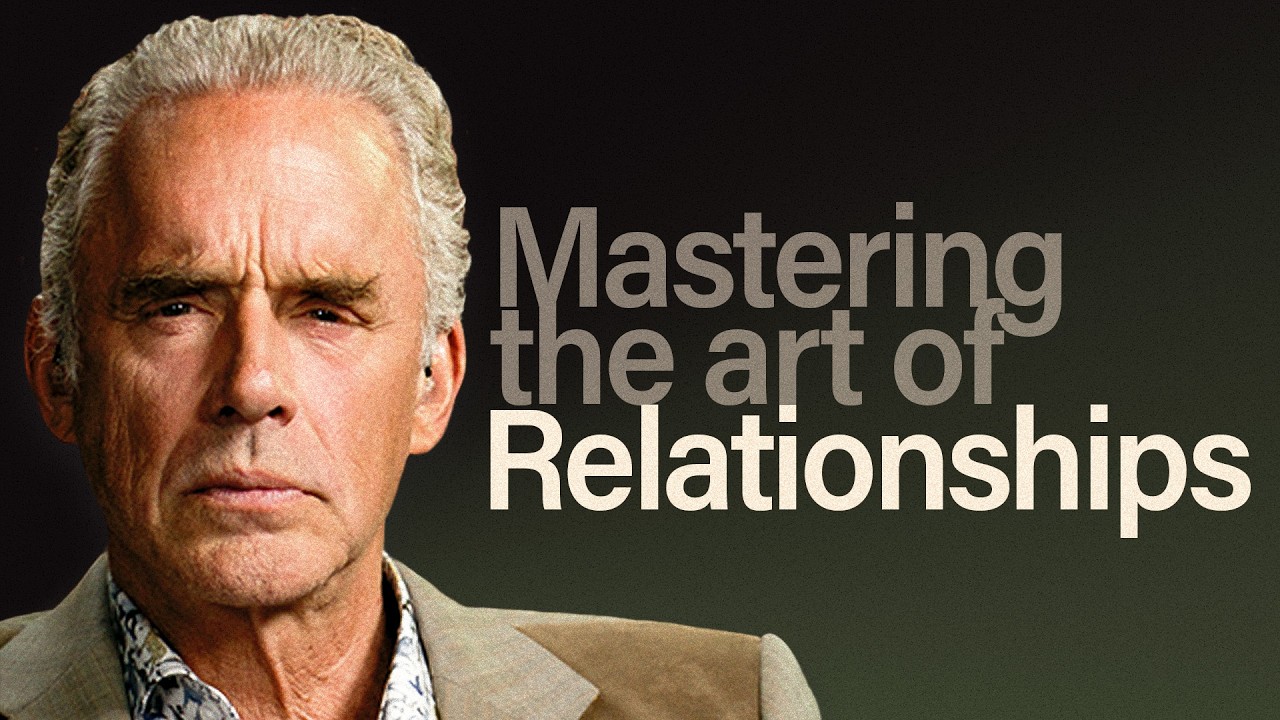
Master Relationships, Improve Your Dating Life, and Make Marriage Work | Answer the Call | EP 571
Watch on YouTubeVideo summary
Dr. Peterson emphasizes the importance of integrating past relationship trauma into new partnerships by encouraging individuals to understand their history through methods like writing an autobiography or dividing life into epochs to identify unresolved emotional triggers. He argues that disproportionate reactions often stem from buried betrayals, requiring partners to practice humility rather than pride during conflicts, noting that winning arguments is impossible in marriage because it causes permanent damage. To maintain harmony as romance naturally declines over time, couples should remember their love for one another daily as a spiritual practice and allow each other room to learn difficult skills slowly without immediate criticism.
In the context of new parenthood, he advises fathers working from home during an infant's first nine months to prioritize supporting the mother so she does not become exhausted or resentful, while also engaging in active play that pushes babies beyond their comfort zones to build trust and physical coordination. Mothers are encouraged to communicate when reaching limits rather than suppressing needs until resentment builds, avoiding delusions of perfectionism where parents believe they must be one hundred percent available at all times. When discussing LGBT ideologies with children in multicultural households, he suggests taking cues from the child's readiness and establishing open communication habits like dinner table discussions using a "center and rings" strategy that defines long-term monogamous heterosexual couples as the ideal center while allowing for concentric deviations involving experimentation or alternative family structures.
Regarding cultural integration and identity, the speaker identifies Joseph Campbell's work on the hero myth as a key source where traditional narratives across diverse cultures share a structure approximating this heroic journey. He criticizes postmodernism and its skepticism toward meta-narratives attributed to Jean-François Lyotard for leading to nihilistic fragmentation where individuals select convenient micro-narratives instead of uniting principles, which causes confusion, anxiety, aimlessness, power madness, and ultimately culture wars when these competing narratives clash. For navigating multicultural identities involving multiple languages and traditions, he recommends waiting until adolescence if issues arise and studying thinkers like Carl Jung and Mircea Eliade to find profound commonalities across different cultural systems rather than accepting radical fragmentation as the end goal.
The overarching message concludes that parents should generally not intervene unless specific issues arise as children mature later on, trusting in their natural trajectory when they are thriving. The segment ends with a call for viewers to share questions via the video description link, reinforcing the idea that rejecting overarching narratives leads to societal instability while embracing shared human experiences fosters unity and purpose across diverse backgrounds.
Read the full video transcript
You don't win an argument with your
wife. You never win that. Part of your
defensive mechanism and your pride is
going to be well this time for sure.
>> Sometimes though.
>> Yeah.
>> Yeah. Well, it's convenient when that's
the case.
>> What's some advice that you could give a
man my age on how best to integrate or
maybe conquer the ghosts of past
relationships?
>> The core of the question was, "What can
I do to ensure that I'm not dragging the
past into the future?" Understand the
past. Understand the past. There will be
times when you or your partner were
betrayed in the past by yourself, by
someone else, doesn't matter. There's a
betrayal. And then when I suggest that
it's you, you're going to get defensive.
Partly because you don't want it to be
you. And partly because there's a part
of you that knows that there's something
underneath that that's going to be very
unpleasant to uncover. You also have to
allow your partner to do a good thing
badly. When they first start to listen
when they first start to help and
untangle, you got to let them flail them
about a fair bit. People will often do
something difficult twice. Go on a date,
for example, when they haven't been with
each other for a long time. It won't go
well and they'll think, "Well, we're
certainly not doing that again." That
happens to people. Then they don't have
any romance for decades. That is not
wise. That's not wise.
In this episode, we're talking about
marriage and relationships.
So, that should be interesting.
Fortunately, my husband doesn't watch
anything I do. So, first on the line,
John in Chicago.
>> Hi, John.
>> Hi, Dr. Peterson. Thank you for having
me on the show.
>> Yeah, thanks for offering.
>> I'm I'm 53 years old. I've been divorced
for about nine years. Um, during those
nine years, I've purposely devoted a
very substantial portion of my time,
effort, and attention to my son and his
predisposition for acting. Recently, at
the urging of my highly extroverted
17-year-old son, and after quite a bit
of thought and feelings of terror on my
part, I took his advice and started
dating. Thankfully, after taking that
step, I've started dating a rather
fantastic woman. During the adventure of
our fivemonth relationship, I've
seriously discovered the importance of
having an intimate partner in my life,
and we've even discussed the possibility
of spending the rest of our lives
together. So, my question is, based on
the abbreviated description of my
situation, what's some advice that you
could give a man my age on how best to
integrate or maybe conquer the ghosts of
past relationships and life choices to
properly set the foundation for a new
relationship to last the rest of our
lives. I have a program that you might
want to try online called Past Authoring
that helps people write an
autobiography.
I would say that it would be useful for
you since you're concerned with
conquering the ghosts of the past, which
is a very wise thing to do at your age
with your wisdom.
And when you're wanting to embark on a
new path forward with clarity and with
the demons of the past understood and
relatively conquered. Now
we organize ourselves neurologically at
the highest level
through language and story.
and your life to date properly
understood
would make a coherent narrative. Now,
that's hard because you have five
decades to contend with and there will
be elements of your past that aren't
well mapped and those are the pitfalls.
Everything you don't understand about
your past is a pitfall waiting for you
to fall into in the future. Now, one of
the ways that you can understand where
those pitfalls exist is that you'll have
memories of the past that are still hot
and active. They still have emotional
significance. Now, if a memory that's
more than a year and a half old still
has emotional significance, that's an
indication from the anxiety alarm
systems that you did not mine that
experience for its full significance.
And that means that you still have
something to learn to avoid falling into
that pitfall again in the future, which
is what you indicated that you want to
do. So I would say that you could
profitably spend some time writing down
your life. Now the way the program works
and you don't have to do the program,
you can do this on your own is that it
asks you to break your life down into
seven or eight epochs. So sometime
people do that by um their
relationships. Sometimes people do it by
their educational progression or their
career transformations.
Whatever way seems reasonable to you or
you know diff different chunks of age.
Whatever way seems reasonable to you to
break down your life is fine. And then
to think through what the si most
significant positive and negative events
were to lay them out. To lay them out in
a way that helps you understand why the
positive events were positive. What you
did right and what the circumstances
were so that that positive outcome was
most likely where you went astray. How
you contributed to that. How you might
deal with that in the future. You want
to do that in a manner that brings you
up to date. And so that'll help exercise
and I don't mean e physical exercise, I
mean demon exercise. That'll help
exercise the ghosts of the past. Now the
rule here to understand is the the
principle to understand here is the
actual principle of memory. You do not
remember the past. So you have an
accurate objective record of the past.
That's actually impossible because you
can't have a comprehensive record of the
past. You remember the past so that you
can duplicate what was good about it in
the future and avoid what was bad about
it in the future. And that means you
have to have derived the appropriate
moral which is the point from the
outcome. And so it's very useful to
bring your narrative up to date. Then
you know where you are. Once you know
where you are, you can plot your future.
You can plot your future together with
your new partner. And so the reason I
recommended this in particular in
consequence of this question was because
the core of the question was what can I
do to ensure that I'm not dragging the
past into the future. It's like
>> understand the past, understand the
past, right? Delve into it.
>> That's good. This is interesting because
you get deep into it and I've got some
like practical tips because I just not
just actually because it's been a number
of years that I've been remarried but I
went through something similar. Um what
I noticed I noticed
try and figure out what your concerns
are and for lack of a better word your
triggers are. So, I noticed
that when I was in certain situations
that were bad in the past that had a
similar pattern, I'd have an emotional
reaction that was way off the charts.
And I had to recognize, oh, I'm
recognizing a pattern from the past, but
this isn't the same thing. It just has
certain similarities. So, that's a
that's a me problem. But then I'd talk
about it with my husband, and he started
to pick up on it once we noticed this
happened a couple of times. and I'd say,
"Okay, this is this is freaking me out
because of what happened in the past."
Uh, and then we'd communicate through
it, which was really useful.
>> Okay. So, one of the things that you're
pointing out is that, and this is
extremely useful, is that you can watch
yourself or your partner for emotional
responses that are disproportionate to
the trigger that recur. Okay. Now, to
investigate those, you have to take a
trip to Dante's Inferno. Okay? So, the
the book The Inferno is a story of a
voyage to the underworld, a voyage to
hell. Now, here's the idea is that under
So, imagine there's a trivial trigger
for a relatively profound emotional
upset. Okay, that means there's
something underneath it. Okay, how far
underneath? Well, that's what you have
to dig into to find out. Dante put the
betrayers
right next to Satan in the depths of
hell, so to speak.
>> So often what you'll find with yourself
or with your partner, and this is almost
inevitable in any relationship, is that
there will be times when you or your
partner were betrayed in the past by
yourself, by someone else, doesn't
matter. there's a betrayal and that has
meant left you unable to trust and hyper
sensitive about any situation that's
reminiscent of that. And some people
some people are just who some people
who've been betrayed continually who've
never had a good relationship let's say
with if they're a woman with a man yeah
they're they're just like that they just
have like a hundred triggers like that.
>> Yeah. No wonder. And no wonder but it
means unfortunately that you have to go
to the bottom. And that's very difficult
because one of the things you'll find
too is that
>> so let's say I identify that in you.
Well, first of all, you're going to see
me as the cause.
>> Oh yeah.
>> So that's going to that's hard. And then
when I suggest that it's you, you're
going to get defensive partly because
you don't want it to be you. And partly
because there's a part of you that knows
that there's something underneath that
that's going to be very pleas unpleasant
to uncover. And then you're going to be
irritable and get angry as a defensive
mechanism. And then if I keep pushing,
you'll cry and make me feel like I'm a
bully. But if so, this has to be done
very carefully.
>> It might also be an emotional release
though, crying. It is an emotional
release for
>> for from my experience. And this didn't
take me very long because I had already
done a lot of work
and was aware that this was going to be
a problem. Yeah.
>> So when I saw myself, okay, my like
heartbeat is going up. Something happens
that reminds me of a past situation. My
heartbeat goes up and I get flappy, like
really flappy, like I'm not doing this.
Absolutely no. Huge boundaries. And it's
like, whoa, where did this outburst of
emotion come from? And then I could go,
okay,
I'm scared. Like that's the main thing
is I'm scared and that's not an
appropriate response. Um, I feel like
what worked for me was
>> like taking a minute and breathing and
calming down and being like, "This isn't
the same."
>> Trying to retrain your nervous system or
something. This isn't the same.
>> Or even this might not be the same.
Right. That's a good initial step.
>> That Yes, that's a good initial the
same. Right. And then there's other
attitudes that you can adopt that are
helpful. Like if you're running into a
recurrent problem with your partner,
there's there's a couple of
possibilities. It's you. That's one
possibility. It's the other person.
That's another possibility. It's some
situational variable that you haven't
all considered. Now, the attitude you
have to take then this is this is hard
to do. This is the attitude of humility
rather than pride is even if it's only
5% me,
it would be in my best interest and my
partner's best interest and the best
interest of our marriage to fix it. So,
I'm going to listen to what this other
person says. You know, part of your
defensive mechanism and your pride is
going to be, well, this time for sure
it's
my partner.
The probability that's 100% them is very
low. And sometimes though and battle.
>> Yeah. Yeah. Well, it's convenient when
that's the case. The the reason that
humility is a religious practice is
because it's extremely useful to adopt
the attitude that you might have
something to learn, right? Because then
you can keep learning.
>> And the goal, the mutual goal should be,
and this is why the marriage
vow has to be sacred. It has to be deep.
the the the the aim should be let's live
in peace and harmony like yeah let's
solve this
>> not let's win
>> yeah that's for
>> or I want to win more than let's
>> or something terrible in me wants to win
you don't win an argument with your wife
that you never win that it's not and if
you win repeatedly she just loses
repeatedly that's a very bad strategy
the goal should be
we'll talk about this badly foolishly it
as the best we can
until we've sorted out. And that's
the more the person you're with or you
has been hurt, the harder that is. It's
it's hard. And it often takes,
especially someone who is not practiced
at this. You know, they'll be upset
about something. It can take them a week
to figure out what's actually bothering
them. It's very hard to get to the
bottom of things.
>> Yeah. You need to practice, but practice
does work.
>> Practice definitely works. Yeah. Yeah.
And and getting your aim straight works.
It's like
>> I don't want to I don't want to have the
this fight with you
>> for the rest of time.
>> Well, remembering you like the person.
If you like the person, that really
helps. It's like, wait, no, I do like
you.
>> That Well, that that is it's a very good
thing to remember because that also
helps you fight against the proclivity
to win. It's like you got to remember
that you love the person. This is
something this is something you can
really practice in your marriage. Like
as a practice, look at your wife and
remember
when that you love her. Remember that.
Bring it to mind. Bring that feeling
that you had when that was self-evident.
People, you know, often romanticize the
early stages of a relationship when that
intense romantic love love first
manifests itself, you know, and everyone
says, "Well, that declines with time."
Well, it declines with time if you don't
practice it. Just like everything else,
it doesn't decline with time if you
practice it. And you can Our culture is
very clueless about such things. We we
know virtually nothing of spiritual
practice. We don't practice humility,
right? You have to practice that. We
don't practice gratitude. To practice
gratitude means you remember what you're
grateful about and search for it
genuinely every day or every moment. And
you do the same thing with love. You
have to remember and that can really
help you when you're trying to sort
through something complex. And then you
also have to have the trust that's
courage rather than the trust that's
naivity. Right? It's like I'm going to
put you in my in I'm going to put me in
your hands when I'm most vulnerable.
>> Right. So, you don't want to violate
that trust.
>> Yeah.
>> And if you do violate it, then you want
to sort that out, apologize, and try not
to do it again. The the other thing I
would say just to close this off is you
also have to allow your partner to do a
good thing badly. Like when they first
start to listen, when they first start
to help and untangle, you you got to let
them flail about a fair bit. And you
have to remember since you're married
that it might take them 50 times to get
it right. Just like it might take 50
dates or 50 meetings before you're even
vaguely good at it. 50 negotiation
sessions. So 50 isn't very many if
you're going to have to do something
10,000 times in your life.
>> Right? People will often do something
difficult twice. Go on a date for
example when they haven't been with each
other for a long time. It won't go well
and they'll think, "Well, we're
certainly not doing that again." It's
like, "Oh, really? You're not going to
do that again ever?" And and then you
That happens to people. Then they don't
have any romance for decades. That is
not wise. That's not wise.
Are you tired of spending countless
hours and dollars on health and beauty
products that promise to make you look
and feel younger without seeing real
results? That's where Fatty 15 comes in.
It's actually the first new essential
fatty acid discovered in over 90 years,
which is pretty incredible. This
nutrient called C15 strengthens our
cells and cellular level and has three
times more cellular benefits than
omega-3 or fish oils. What's really
interesting is that up to one in three
people might be deficient in C-15, which
can cause something called cellular
fragility syndrome. Basically, when our
cells become fragile and age even
faster. When our cells don't have enough
C-15, they break down more quickly. And
since our cells age, our bodies do, too.
The good news is that C-15 actually
repairs age related damage to cells and
protects them from future breakdown.
Studies show that 72% of users report
seeing benefits within 16 weeks, like
better sleep, healthier skin, improved
energy, and even smoother functioning
joints. It's clinically proven to
improve things like liver function, and
red blood cell health within just 3
months. Plus, Fatty 15 comes in this
gorgeous reusable glass jar with
convenient refills, shipping right to
your door. Fatty 15 is on a mission to
optimize your C-15 levels to help
support your long-term health and
wellness, especially as you age. You can
get an additional 15% off their 90-day
subscription starter kit by going to
fatty15.com/person
and using code peterson at checkout.
>> Up next, we have Tahani in Tennessee.
>> Hello, Tahani. How are you doing?
>> Doing well, Dr. Peterson.
>> Nice to see you. Away you go.
>> Good to see you. Okay. Um, my name is
Tahani, as you know, and I'm a
stay-at-home mom to our seven-month-old
son, and my husband, Michael, is the
sole provider for our family. My
husband's very hardworking and also
eager to be involved in the home. But
sometimes neither one of us knows what
that involvement should look like from
him. So, first of all, how many hours a
day are ideal for him to be home with
the family since he makes his own hours?
And is it essential to take consistent
days off each week or should he just
work and earn as much as possible? More
importantly, when he is home, should it
be diaper changes, bottles, and bath
time like being a Mr. Mom or should he
focus on playtime only? Basically, how
can someone who works a lot make the
greatest impact as a father and what can
I do as a wife to encourage him and
support that involvement from my
husband?
So
for the first nine months, the in my
estimation, the primary role of the
father is to
support the mother in her intense care
of the infant and to spell her off. And
so he should be focusing on the two of
you. And how much he should do that is
dependent to some degree on how much you
need. And because his goal should be to
make sure that you aren't overt tired
and pushed beyond your capacity. Now
whether or not how much he should work
and make money that's something you guys
have to negotiate and you will have to
negotiate that with your own level of
exhaustion and and need. Now having said
that, I would also say that those first
nine months when the baby is really a
dependent infant are also a time where
the father can begin to establish a
relationship with the child. And any of
that care that you described that's
practical, feeding, changing, etc. is is
a way of doing that. But holding the
baby and starting to play like even with
a very young baby say 6 months 5 months
a father can start to play games. So,
one game you can play with a very young
infant is to hold the infant up and to
make eye contact, which infants quite
enjoy. And to you can make a little
sequence of noises, you know, like a
little melody or count. 1 2 3 tap heads.
1 2 3 tap heads. One, two, three, tap
heads. One, two, three. Then don't.
That's a little surprise because a game
is often, especially with an infant, a
game is the establishment of a
predictable routine with a surprise
variant. And you'll see babies will
laugh about that. Now, if the surprise
is too great, they'll cry. So, you got
to kind of calibrate that. But that's a
very simple game. And men are
particularly good at playing with young
children. And when men are playing, what
they tend to do is to push the baby
outside of his or her zone of simple
comfort into the zone of intense play
into being thrilled often. And they do
that by
like pushing the baby in various ways
beyond his or her ordinary physical
limits. stretching,
lifting up, lifting down, um flipping,
and all of that is a way to help the
baby explore the limits of his or her
own physical being, the distinction
between pain and pleasure and to develop
trust. Like the most important thing
that your husband can do apart from
supporting you and making sure you're
not burned out and um unable to enjoy
and be fully engaged in what you're
doing is to play with the infant. Now
that play involves the sorts of things I
described, but also the physical contact
and physical touch is extremely
important to infants. And so your h the
the goal of your husband is to push the
baby continually to his or her physical
limits in a manner that both find
enjoyable and um what it's it's
enjoyable because there's an element of
fun and surprise to it. But there's also
an enjoyment in the mutual understanding
that develops and the bond that exists
because of the trust. Another way of
analogizing it, I would say, is your
husband is going to is going to dance
with the baby. One of the things you see
with kids that aren't attended to enough
physically, especially as they get to be
around three, is that they're they're
vague in their attention and they
they're uncordinated
and and ungraceful in their movements.
The Dowists would regard that as the
state of being an uncarved block. And
what you see in in in children like that
is they haven't been attended to enough.
they haven't been sharpened up, you
know, and men who are attending to their
children intensely sharpen them up. They
keep them on their toes. They play
little tricks on them and they make sure
they're awake and they push them to
their limit. And they do that in a
manner that's confident and playful. And
that makes the child
understand his or her embodiment much
more deeply and also establishes an
immense love of play and a solid basis
for trust and adventure and that that's
a man's role. So now women can
>> what what about So I'm
>> I had this conversation with mom
actually a bit ago because I work from
home and I have for what seven or eight
years. Um and my husband works from home
and so it's complicated to know who does
what.
>> Um what I figured out was helpful just
more practically so you can tell me what
you think about this was diaper changes.
I I feel like you weren't a fan of
diaper changes. No, I didn't mind once I
learned how to do it.
>> Really helpful, especially if you're
breastfeeding because then you're
already kind of on call all the time and
attached to the baby. Diaper changes
were are really helpful. Doesn't take
very long, but those were really
helpful. Uh, and then she asked about
how much per day, which is hard to say,
too, but you mentioned enough so that
you're not resentful basically and that
you're still enjoying the baby.
>> Yes. Um, and we figured that was at
least a little bit in the morning, a
little bit in the evening. That's
minimum.
>> And then I think it's tricky when people
work from home cuz it's kind of like,
oh, you're in the other room. What are
you doing? I'm starting to get tired.
You know, maybe I'm a bit annoyed. Um,
and taking like five minute breaks to
come say hi is really beneficial, too.
>> So, I think this is just for the mom.
explain that to
>> well like you get especially with little
babies you get overwhelmed es especially
if you're sleepd deprived it's the first
3 months
particularly with your first but after
it says say the baby's fussy you haven't
slept the baby's not sleeping well
you're trying to breastfeed you're not
sure if they're hungry you're just not
sure really what's going on you're like
I can't hold a crying baby
>> anymore
that's the point when you're like can
you take the baby for five minutes I
need to breathe
>> yeah that you you have to watch the role
of the husband in the first seven n to n
months is really to keep a really sharp
eye on the mother
>> and make sure that
>> food helps too. Yes. And make sure that
she isn't pushed beyond her limits and
that's problematic because she's
constantly on call and her sleep is
disrupted. So, you have to keep an eye
on that. And and if she gets teary or
upset or irritable, and those things
will all happen,
she has to be spelled off. And so
>> Oh, that's what you meant by spelled
off. I have no idea what that means.
>> Yeah. Yeah.
>> Um I think it's also the role of the
wife or the mother to communicate with
the husband so that when they're at
their limit, they go,
>> "I need help right now."
>> Yeah.
>> Instead of sitting there and like
freaking out. Yeah. And you're not being
needy because the first period of time
is really crazy, especially if you're by
yourself and you don't have help kind
of.
>> Uh so it's okay to be like, I'm out my
limit right now. I need a breather. And
a five minute breather
>> is actually pretty decent.
>> It's when there's no
>> Yeah. Well, that's that's uh for on the
mother's side, like she has to guard
herself against the guilt that says I
should be 100% thrilled to be with my
baby all the time. And it's like, no,
>> 90% of the time will do or 80% or 75%.
Right. It's still a lot.
>> It's still a lot. Yeah. and and she you
know when you're taking care of someone
and this goes for the elderly or for
people who are ill too while you're
taking care of them especially if it's a
long-term
arrangement you have to ensure that
you're taking care of yourself because
you won't be able to do it effectively
in the long run if you're pushed beyond
your actual capacity and that's well
that's where you start to do things like
consider your resentment as well. If you
notice that you're irritable and
resentful, you want to determine and
talk to your partner about whether or
not you're just being irresponsible and
immature because there's a lot of
maturation that has to happen when
you're a new parent or whether you're
demanding too much of yourself, right?
That's also a kind of delusion. You
know, Eric Noman, who was Carl Jung's
most most accomplished student by a lot,
said that you shouldn't try to be better
than you are. And what he meant by that
was not don't improve because you should
improve, but don't fool yourself into
thinking that you're a better person
than you actually are. Not least because
some of that irritation you might feel
at being on call constantly is actually
a manifestation of a necessary
self-protective mechanism.
>> Yeah. Right.
>> Agreed.
>> Yeah. Yeah.
>> Shopify powers millions of businesses
worldwide supporting everyone from
established brands to entrepreneurs just
starting their journey. You can create
your professional storefront
effortlessly with Shopify's extensive
library of customizable templates
designed to reflect your brand's unique
identity. Boost your productivity with
Shopify's AI powered tools that craft
compelling products, descriptions,
engaging headlines, and even enhance
your product's photography, all with
just a few clicks. Plus, you can market
your business like a pro without hiring
a team. Easily develop and launch
targeted email campaigns and social
media content that reaches customers
wherever they spend their time, online
or offline. If that's not enough,
Shopify offers expert guidance on every
aspect of commerce, from inventory
management to international shipping
logistics to seamless return processing.
If you're ready to sell, you're ready
for Shopify. Sign up for your $1 per
month trial period and start selling
today at shopify.com/jbp.
Go to shopify.com/jbp.
Again, that's shopify.com/jbp.
>> Next caller.
>> Let's do it. We have a caller from Iowa.
>> Hello, Dr. Peterson. The question I have
for you is my wife and I have three kids
uh between 1 and seven and the question
is what is the right age or maturity to
discuss LGBT ideologies? Both of my
siblings identify as LGBT which has
really sped up our timeline and is there
any way to discuss this without ruining
their childhood innocence? We want this
information to come from us as their
parents and not from anybody else. We're
trying to prepare them for the world and
want to be a trusted source of
information for them. So, how and when
do we discuss this?
>> Well, I would say as a rule of thumb
that you take your cues from your
children in a situation like that. It
isn't necessary for you, all things
considered, to provide information
you're not being asked about. Now you'll
if you observe your children carefully
an example might be that when when
children are ready to be toilet trained
they'll show an interest in such things
that's somewhat subtle and will
disappear if you ignore it but that's a
good time that's a that's a time to
strike when the iron is hot. your
children will bring if you set up a
regular habit of communicating with them
and the dinner table is a very good time
to do that because that's a regular
meeting time or perhaps before bed
that's sometimes a time when one parent
or the other or both can spend some
intense communicative time with your
kids. If you make a habit of that being
the time to bring up issues or concerns
or ask questions, then that gives your
children an opportunity to bring their
concerns to you. And so I would say you
want to establish that communicative
pattern as a habit and then you want to
take your cues from your children. Um,
now let's see if I can be more specific
about that on the LGBT front. Um,
I'll tell you,
I'll give you an overarching strategy
for this. We worked this out at ARC,
which is the Alliance for Responsible
Citizenship. This is a group that I
helped found that is trying to develop
an vision for a modern classic
liberalism and conservatism. And one of
the
most tense negotiations we had with the
interested parties of about 40 people, a
number of whom were gay and quite um
what would you say? They're well-known
people. This was the hardest discussion
that we had. It took us about a year to
really sort it out. And here's how we
did it. And I think it's right.
We presented the proposition that every
concept
has an ideal at the center and
concentric rings of deviation from that
ideal around it. And I by deviation I
also don't mean I don't mean deviation
in the necessarily pathological way. I
also mean experimentation.
The core of sexual
identity
that's
socially harmonious and productive in
the medium to long run is has to be
long-term monogous committed child-c
centered heterosexual couples. It has to
be. Well, why? Well, because that's the
only arrangement, the minimal
arrangement that ensures
average
contentment, satisfaction,
stability for children, propagation into
the future, and the foundation for
culture. Okay. Now, so now you have the
ideal in the center. The that's the flag
you plant in the center. Now you face
another conundrum. It's like, okay,
well, fine, but who
approximates that ideal? perfectly. And
the answer is really nobody. You know,
no marriage is always happy.
40 to 50% of people are likely to get
divorced. There's no shortage of single
parents. And there's the um LGBT
I'm not going to include the T because
that's just going too far in my
estimation. Community. Um
there's all sorts of ways we deviate
from the ideal. And some of that's a
matter of experimentation. There are
other forms of family that can work.
Although I would say the farther you get
from that core ideal, the more difficult
it is to make it work and to integrate
it. And so that's the sort of meta
strategy. So then knowing that you can
you can say to your children look if you
deviate from that path
it's going to be extremely complicated
for you at minimum it's also complicated
for everyone else. Now, if you're
willing to take on that responsibility
and you feel compelled by necessity to
wander away from the ideal,
then
then understand that that's going to be
difficult and
and also inevitable over the course of
your life. And what would what does that
mean? It means have some patience and
tolerance because you're going to
deviate from the ideal just like people
who
occupy
different forms of relationship.
I don't know a better way to
conceptualize that for kids. Now, you
know, your kids have to be somewhat
sophisticated
to understand that, but I think if you
let them ask the questions, then you'll
know when they're ready for the
information. I wouldn't
act precipitously
even to inoculate them, so to speak,
against the ideology. If they're
disturbed and you've set up the
situation so that open communication is
possible in the household and they
encounter something at school or among
their friends or online that's confusing
to them, then they'll bring that to you
and you can answer enough so that
they're satisfied and then you can wait
for the next questions to arise. I don't
really know a better way of dealing with
it than that.
>> I like that answer. We managed a
consensus among the ark group
>> which is composed of people with very
diverse viewpoints. We we managed a
consensus around there the the notion of
a center with rings of experimentation
around it that also gives you some play
in the system right is because people
are people can be quite different from
one another and you still need a
standard. It's like on average this will
work best. It's like but I'm not
average. It's like maybe you're not like
probably you're more average than you
think and you should pray that that's
true because if you really are different
like different one definition of
different is special. Another definition
of different is miserable and doomed.
Yeah. Right. And those can go together.
And maybe you are special and you have
to walk your own path. But boy,
you walk off the straight narrow path at
your own peril. That doesn't mean it
isn't necessary. Might be necessary.
>> I also I don't think kids care. I
remember when I was young and I I feel
like you used to pull us out on days.
We'd have these random homeschool days.
I don't know why we were pulled out on
certain days, but I feel like it was to
avoid certain indoctrination things that
were already happening in our school.
But we had Julian had a really good
friend
>> whose parents were lesbians.
>> Mhm.
>> I don't think anyone cared really.
>> They're like that's different. Like we
didn't really think about it. We're just
like that's not a mom and a dad. It's a
mom and a mom. That was about it.
>> That's also the kind of tolerance that
I'm talking about. And I think that
that's quite typ that was very typical
in Canada in the 1990s.
Yeah. like the the basic we had already
established the social millu that the
progressives now claim to be aiming at.
>> Oh, I know. Nobody cared actually just
destroyed it because now we don't have
that anymore. Now we're less tolerant.
>> Where where we lived, we where we lived
in particular, no one cared. No one
cared if you were black. No one cared if
you were Asian. No one even really
noticed, especially the kids. No one
cared if you were gay. The rule was um
don't be too annoying
and
assume goodwill and everyone will get
along and that worked and then well then
all hell broke loose around 2010 and
that all much of that fell apart and I
could see some of that starting to
happen when you guys were kids but
mostly you
>> 2000
>> you were also raised in quite a
progressive millu I mean you went to
alternative schools. The neighborhood we
lived in was champagne socialist. Like,
and none of that was none of that was a
problem for me until 2016 even.
>> And then
it went sideways.
>> Yeah,
>> that's for sure.
>> We've all heard common myths like we
only use 10% of our brains, but here's
one that might actually shock you.
Thread count is a huge myth that people
believe when shopping for sheets. Thread
count is simply a measure of fabric
density and isn't actually a good
indicator of quality. If you truly want
great sheets, you need to look at thread
quality, not count. That's why Bowling
Branch focuses on using the highest
quality organic cotton threads, creating
long-lasting sheets that actually get
softer over time, rather than relying on
inflated thread count numbers to impress
customers. Bowling Branch sheets are
crafted from the finest 100% organic
cotton and a soft, breathable, and
durable weave that delivers quality you
can feel from the moment you touch them.
What makes them even more special is
they become softer with every wash,
improving over time rather than wearing
down. With their 30 night worry-free
guarantee, you can experience this
exceptional comfort risk-free, ensuring
you'll love how these premium sheets
transform your sleep experience. I got
to tell you, a little while ago, I was
camping. I was in a tent. It was hot. I
could not wait to get back to my Bowling
Branch sheets for a good night's sleep.
Feel the difference an extraordinary
night sleep can make with Bolan Branch.
Get 15% off plus free shipping on your
first set of sheets at
bolandbranch.com/person.
That's BolanBranch. B O L L A N D
branch.com/personson
to save 15% off and unlock free
shipping. Some exclusions do apply.
>> We have a pre-recorded call from a
viewer in Beijing, China. So that's
cool.
>> Yeah. Yeah. Well, I'm looking forward to
that.
>> My name is MKA. I'm from Romania and my
wife is from India. We live in Beijing,
China. We have two boys who were born in
Beijing. Their ages are two and four.
The children have Romanian passports. We
have three home languages. English,
which is dominant, Romanian, my
language, and Chinese, spoken by the
live-in babysitter. The children go to a
British school where I also work as a
teacher. We celebrate holidays and
festivals of all three cultures, Indian,
Romanian, and Chinese. My question is as
follows. Given that my children are
growing up in a multicultural
environment with influences from Indian,
British, Chinese, and Romanian cultures,
how can we as parents best navigate the
balance between preserving the unique
values of each culture and ensuring they
develop a strong sense of personal
identity?
>> That's cool. Three languages. Good job.
I guess I would I would ask to begin
with how you and your wife negotiate
that.
No, it it would that that's a very
that's a very hard question because
multiculturalism brings the advantage of
diversity, let's say, and that's
multiplicity and difference of opinion
and the disadvantage of confusion and
conflict on the conceptual and ethical
side. And so one definition of
multiculturalism is bulcanization. And
that's the precursor to continual war.
And so those who think that diversity
brings integration are by necessity are
absolute fools. Obviously that isn't the
case. How do you negotiate that in a
household?
You're teaching your children have the
opportunity to learn these different
languages
and they're exposed to a variety of
different cultural influences. If
they're thriving,
then I would leave that question alone
until they're in their teen years.
And then I would say if that becomes an
issue for them, if the fact that they're
pulled in multiple directions by their
different cultures becomes an issue,
then they'll have to educate themselves
in relationship to how an integrated
vision of culture might be
formulated. And the best sources I know
for that endeavor are the thinkers in
the school that aggregated around Carl
Jung and Merche Eliata who was a
Romanian historian of religions. And
what the what that school of
psychological, sociological, and
historical investigators attempted to do
was to map out the commonalities of
pattern across different religious and
sacred systems. Now you see there's a
there's a pre cursor to this uh uh um
precedent for this that's very very
deep. Western civilization arose because
the philosophical tradition of Greece
mapped strangely
onto the prophetic and legal tradition
of Judaism. And the synthesis of those
two really laid the groundwork for the
western tradition. And what what you saw
in Greece was the emergence of a
conceptualization of logos. And you saw
a parallel emergence of a conceptual
conceptualization of logos particularly
in Christianity. And it turned out that
there was a parallelism between those
two that allowed them to be amalgamated.
Now the Yunian school, the school that I
was a part of and a leader of, were
looking at a synthesis of that sort that
was deep across an even broader range of
cultural traditions. And I don't know of
any thinkers that did a better job of
pulling together across that diversity
than that school. I would like to think
that the work that I've done
particularly in my book Maps of Meaning
in We Who Wrestle with God, I'm working
on that as well in a new book called The
Foundation of the World, which is an
analysis of the gospel stories, is a
continuation of that integration
tradition. See, you're asking a very
difficult question, which is how do you
bring harmony out of radically different
cultural traditions. And what you look
for is profound commonalities, but you
have to go way down into the structure
of the beliefs to find those
commonalities. And you won't only find
commonalities.
So, this is a massive you're asking the
same question as how do you bring a
monotheism out of a polytheistic state?
Um, these are questions that take
cultures thousands of years to answer.
And so it's very difficult to do
something like that in the span of your
own life. If you feel obligated or
required to do that, I don't know of a
better source of information than the
writings of the school that I just
described. Carl Jung's works, Merch
Eliata's works, the work of the Bolingen
school. They're the people who did this
properly. um as opposed to the
post-modernists who just accepted
radical fractionation and diversity as
the desired end goal, which is clearly
not the case for you. You want something
to emerge for your children that's
integrated and foundational. So that's a
complicated answer, but there's no
simple way of addressing that question.
Do you think just to wrap this up,
>> do you think
it's I mean absolutely necessary or can
you just wait until the kids's old
enough cuz what I've seen from people
especially who have very strong
backgrounds is putting that on their kid
which is like do you need to make them
I'm Canadian so I almost feel like I
don't have a culture. I feel like that's
kind of like it just doesn't really feel
like that to me. And I was interested in
my background, I guess, like where we
originated, but there wasn't a strong
pull in any direction. Do you need a
strong pull in any direction or can you
just figure it out yourself?
>> Well, you don't need to solve a problem
you don't have.
>> Yeah.
>> Right. And so, as I said to to the
questioner, if his children are
thriving, just leave it be. Like, you're
doing whatever needs to be done right
for the moment. If it becomes an issue
as they mature and that's something that
becomes a area of concern for them well
then you cross that bridge when you come
to it what I tried to lay out was the
sources that would be particularly
useful in that endeavor in in more
popular culture people have found their
path to this kind of integration
primarily through the work of Joseph
Campbell right and his work on the hero
myth because one of the things that
seems to unite cultures at a very deep
level is that the traditions, the
traditional narratives of diverse human
cultures have a structure that
approximates the journey of the hero
that Campbell was so good at
popularizing. Now, the post-modern types
deny that, but they're they're a pack of
corrupt and self-serving nihilists. So,
and that that is one way, by the way,
that is one way of solving the problem
is that if you're faced with the
conundrum of multiple competing moral
narratives, you can just fractionate and
pick whichever one's convenient for you
at the moment. That is not a good
solution. But that's certainly the
solution that
the academics of the world in the last
50 years have decided that they were
going to adopt. That's why we have a
culture war. One of the reasons we have
a culture war the defining
>> don't do that
>> well the defining characteristic of
postmodernism this is from leotard who
was a Jean Franis Leotard who was a
founder of postmodernism is he said
postmodernism is skepticism
towards meta narratives and what he
meant this is a reflection of the
nichian death of god what he meant was
well there is no paramount uniting
narrative there's just a bunch of
fractionated narratives that people can
micro narratives that people can
inhabit. It's like, okay, fair enough.
But what do you do if the micro
narratives compete, which they do, which
they clearly do. It's like, well, you
get confused and you get anxious and you
get aimless and then you get power mad
and then you go to war.
>> You get riers in California.
>> Yeah. Yeah. Yeah.
>> Thanks for joining us. We hope you
enjoyed and we'll be back to answer many
more questions in the future.
>> Thanks a lot, Mick.
>> Thank you, Dad.
>> Yeah. and to our questioners. Much
appreciated.
>> Do you have a question you'd like us to
explore? Share it with us at the link in
the video's description and let's face
life's challenges together.