Video summary
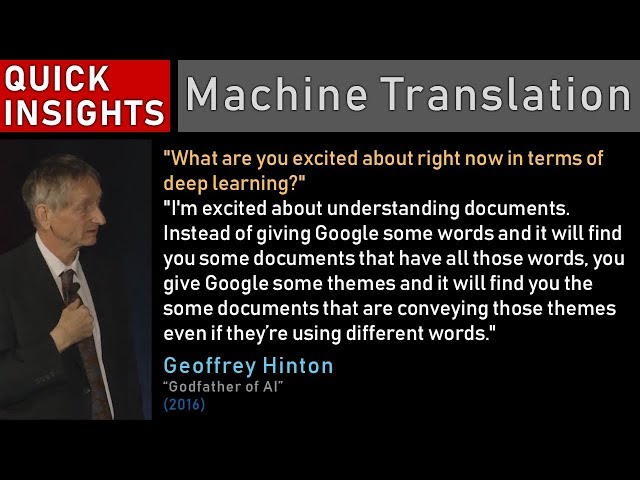
Geoffrey Hinton expresses significant enthusiasm for recent advancements in deep learning, particularly within the realm of machine translation. Although he notes that he has not made direct contributions to this specific area himself, he highlights that some of his students are actively working on it. He predicts a substantial improvement in translator capabilities over the relatively short term, suggesting that current limitations will be overcome soon as these models continue to evolve and refine their understanding of language nuances. Beyond translation, Hinton is particularly excited about the potential for systems to understand documents more deeply than they currently do. He envisions a future where users can interact with vast repositories of information by providing themes rather than specific keywords. Instead of simply searching for exact word matches as one might find today on platforms like Google, advanced algorithms will be able to locate relevant documents based on the underlying concepts and arguments presented within them. This shift represents a move from literal keyword matching to semantic understanding, where systems can identify that different texts are discussing the same topic even if they use entirely different vocabulary or phrasing. For instance, rather than searching for a specific term like "climate change," a user could provide themes related to environmental policy or global warming trends, and the system would retrieve all documents addressing those ideas regardless of how explicitly they state them. This capability would allow users to search for information based on what documents are claiming about their subjects, independent of the exact words used in the text. Hinton emphasizes that this progression is expected to occur over the next five to ten years, marking a transformative period for document retrieval and analysis. The ability to navigate massive datasets by conceptual themes rather than rigid keyword constraints will revolutionize how information is accessed and synthesized across various fields. Such developments promise to make complex research tasks more efficient, allowing scholars and professionals to quickly gather comprehensive insights on specific topics without being hindered by the limitations of current search engine algorithms that rely heavily on exact phrase matching. Ultimately, Hinton's excitement stems from the prospect of deep learning systems achieving a level of comprehension that mirrors human understanding of context and meaning. By moving beyond simple pattern recognition in text to grasping the essence of arguments and themes, these technologies will unlock new ways for humans to interact with digital information. This evolution not only enhances search functionality but also paves the way for more intuitive tools that can assist in research, education, and decision-making processes by presenting relevant content based on conceptual relevance rather than lexical coincidence.
Read the full video transcript
what are you excited about right now in
terms of deep learning sighted about
this machine translation even though I
myself haven't made any direct
contribution to it some of my students
are doing it I think over the fairly
short term we're going to get much
better translators yeah I am excited for
things like understanding documents I
think there's going to be huge progress
there over the next five to ten years
instead of giving Google some words and
they they'll find you all the documents
have those words in you give Google some
themes and it'll find the documents that
are saying that even if they're saying
it in different words and so you're
going to be able to search for documents
by what it is the documents are claiming
independent whatever the works are that
would be kind of useful
you